針對查詢「fort san domingo」依關聯性排序顯示文章。依日期排序 顯示所有文章

2012年8月18日 星期六

Life in Tamsui 1867

Collingwood (1868) [the sulfur springs are still aplenty in 大屯山 area]

Dr FLS Collingwood published this article "A Boat Journey across the Northern End of Formosa, from Tam-suy, on the West, to Kee-lung, on the East; with Notices of Hoo-wei, Mangka, and Kelung." in the Proceedings of the Royal Geographical Society 11 (1867): 167-73.

We have added some notes and also place names in Chinese for easy reference. This article is otherwise a succinct and possibly accurate account of life in Tamsui, 145 years ago:

[P. 167] Tam-suy [淡水] is situated on the north-western coast of Formosa, and possesses an excellent harbour, over the bar of which H.M.S. Serpent, drawing 12 1/2 feet water, passed easily at high water. The entrance is unmistakably marked by two lofty and picturesque hills; that on the left, termed the Kwang-yin Hill [觀音山], having two prominent peaks, of 1720 and 1240 feet respectively; and that on the right, the Tai-tun Hills [大屯山], forming an imposing ridge, of which the summit is 2800 feet high. From land to land, at the entrance of the harbour, is just half a mile; but a considerable spit of sand diminishes it more than one-half. Within the harbour, however, it rapidly increases to three-quarters of a mile and even a mile in width, affording good anchorage for larger vessels. Immediately on the left hand, on entering, is a small Chinese fort [Note: possibly the 白砲臺White Fort, destroyed by the French during the Sino-French war in 1884]; and half a mile higher are the ruins of an old Dutch fort, a square, red-brick, casemated building [Ft San Domingo - 紅毛城], once, no doubt, of great strength, and elevated 50 or 60 feet above the water's edge. The long rambling town of Tam-suy, or Hoo-wei [滬尾], as it is more properly called, commences a little higher; and consists, for the most part, of a narrow street of shops of a poor description, paved with great cobblestones or not at all, and in which pigs of all sizes and barking dogs dispute the passage, which in some places scarcely admits of two passengers passing one another. The Vice-Consul (Mr. Gregory) resides here, as well as three or four other Europeans, engaged in mercantile affairs or employed in the Chinese customs. The consulate, however, is but a poor building for the representative of Great Britain; for the inhabitants, who are mostly coolies, and upon occasion are a turbulent set of rascals, have a prejudice, forsooth, against building houses more than one story high, and no such dwelling exists in Hoo-wei. [Note: These coolies/rascals were actually hard-working men who knew how to enjoy life and how to avoid natural disasters such as typhoon and, at times, earthquakes.]

[Map of Tamsui of ca 1920 - many landmarks such as the sand-bar and Ft San Domingo, were in existence in 1867, also seen and recorded by Collingwood]

There is a very pretentious joss-house in the town [媽祖宮], of which the stone pillars, elaborately carved, represent, with considerable cleverness, fantastic dragons encircling the columns in high relief; workmen being yet engaged in the task. The immediate neighbourhood is hilly [the 重建街 area], having numerous scattered houses; and a large amphitheatre, just outside the town, forms an immense and well-filled burial-ground [Note: this was, still is, the First Public Cemetery], upon which grows abundance of the rice-paper plant (Aralia papyrifera), which is largely exported from this neighbourhood. The soil is very fertile, consisting of a considerable depth of alluvium, in which are numerous angular and rounded blocks of stone, some of very great size.

The inhabitants of Hoo-wei (Tam-suy), as of the other towns in the route, are mostly poor and meanly clad; the males wearing usually nothing more than a pair of short drawers, or some substitute for them; some of the younger children going entirely naked [Note: in the summertime, a fully clothed child playing outdoors = 痱子heat prickles all over his body]. The women and girls, however, are always decently clothed, very few of the female children being even naked to the waist. Bandaged feet are universal among them [Note: Women and girls in Tamsui have always been well-dressed, even now, and the practice of foot-binding was mercifully outlawed during the Japanese Colonial era].

Rice is abundantly produced in the neighbourhood; but its exportation is forbidden by the Government, on pretence that there is not more produced than is required for home consumption; but by a roundabout method, a considerable trade is, notwithstanding, carried on, to the advantage of the Mandarins. Bullocks, goats, and poultry are difficult to obtain; but pigs are [p. 168] abundant, though few who could witness their disgusting habits and foul feeding would care to eat them. Ducks are also plentiful [Note: not ducks, they were red-faced Muscovy].

Collinwood apparently did not have the opportunity to witness this: A sacrificial pig at MaZu Temple - one of many during 大拜拜 - to be prepared after the celebration into appetizing dishes and served in banquets shared by many

An inferior Mandarin resides here, named Lim-ching-fang [林清芳?], but he is subordinate to the Mandarin of the Tam-suy District, of which Hoo-wei is but an inferior town; the chief town being Mangka, or Bangka [艋舺 or 萬華] [Note: Tam-suy Township is now Tamsui District, headed by Dr Tsai Yeh-Wei [蔡葉偉區長], part of the New Taipei City 新北市].


2009年3月7日 星期六

砲轟淡水 The bombardment of Danshui

Oct 2, 1884: The bombardment of Danshui. In this picture, the French battleships are situated at the mouth of the Danshui River, to the left is Danshui (with Mt Da-Tuen in the background) and to the right is Ba-Li (with Mt Guan-Yin in the background). You can click on the picture to enlarge it. The captions from left to right: landing beach area of the French infantry marines, Chinese military camps, Chinese gun fortress, the Town of Danshui, New Fort, area of Fort San Domingo and British Consulate, White Fort, British warship the Cokshaffer, and the dam line (where the ships were deliberately sunk by the Chinese defenders to block the entry).

1884年10月2日,法國艦隊砲轟淡水的情景.艦隊位於淡水河口,左前為淡水,其後為大屯山,右為八里及觀音山. 可點擊上圖放大. 標示自左至右為: 法軍登陸海灘,清軍營, 沙崙砲台,淡水鎮,新砲臺,紅毛城一帶,白砲臺,英戰艦 Cokshaffer,及清方沉船海防線.

2012年1月10日 星期二

Ft San Domingo - Part 1

Knowledgeable tourists visiting Danshui (now reverted to its historical name "Tamsui") often come to the old 紅毛城 to marvel at the actual presence of the Brits in the relatively recent past. The Fort flew the Union Jack from 1867 onward until 1980 when the lease was terminated - eight years after the UK withdrew its consulate from Taiwan.

The handover of the British Consulate building and the adjacent Ft San Domingo to the Rep of China, however, was not without (bureaucratic) dramas. Here is a correspondence from the UK Far Eastern Department on the subject of Tamsui Consulate, dated April 1 and received on May 15, 1980, apparently by its officers in Hongkong, in which the lingering issue of disposing of the property was discussed:

To enlarge the above documents: (1) in Firefox, click the images to open another window, right click to open menu and select "View image", click on image again to magnify; (2) in Chrome, same as in FF except when right click to open menu, select "Open image in new tab", then click to enlarge; and (3) IE? You are on your own.

2009年7月27日 星期一

Going to school in Danshui

Occasionally, traveling down the memory lane can be fun.

For those growing up in Danshui in the early 1950s, the daily routine was of course going to school, boys to Danshui Elementary School and girls to 文化Wen-Hua ES. Either way, it meant going uphill for many from 中正路Chung Cheng Road, starting from a small triangular area, known to the locals as 三角窗 - with the back of Dr Mackay's head pointing straight up to DES. The photo here looks into 老街the Old Street. Where this huge bust of Dr George Leslie Mackay now sits used to be a concrete machine gun nest. Going in the opposite direction of the side street (i.e., Dr Mackay's right-hand side) is where the Mackay Clinic and the Danshui Presbyterian Church are located; it continued up to WHES.

This Clinic was where 200 wounded Qing soldiers were treated in 1884. In latter days, it was also where Romanized Hoklo alphabet was taught - so kids could read the Bible in Taiwanese (not all kids were so diligent as to complete the lessons, though). Next to the Clinic is one of the the best known landmarks in Danshui, the Presbyterian Church, originally established by Dr Mackay. The brick building on site now is, however, a more recent construction (1932). On its ground level, there was a kindergarten for children from the immediate neighborhood. It is still in operation today.

For older kids, it was a long trek uphill. One of Bill Cosby's comic routines mentioned his dad's going to school in deep snow, trudging uphill - both ways. This never fails to evoke a big smile as it always reminds us of our days in the unpredictable Danshui weather.

This is the infamous hill (right), then a narrow cobblestone passage which all boys must travel. It now looks more like a slope; although it certainly felt differently when you had shorter legs. And when it rained, which was quite frequent, one either went bare-footed holding on to one's snickers or was forced to wear smelly black rubber boots that leaked all the time, even when brand new. It was a wet mess either way by the time one reached the top of the slope. Worse, now one must wade in a river of red mud, known as 中山路Chung Shan Road, to enter the school ground.

Actually, girls might have had harder time going to school, because the slope there was even steeper (see photo below). Wen-Hua ES was next to 淡江中學Tam-Kang High School across from the Little White House. The latter was in a forbidden zone in the 1950s. Farther along the narrow street were the 純德 Girls' High and finally the always gated British Consulate (now 真理大學). Fort San Domingo was also in a nearby forbidden area. Now the whole area is open to tourists. For NT$40, one can peruse the past in both the Fort and the residence of the Customs Chief.

Back to kids going to Danshui ES: At the top of the hill, an original brick house still stands (below left; Chung Shan Road is in the foreground). This was where it got interesting. A flock of red-faced aboriginal ducks (called 番鴨, might have been the black muscovy) congregated here. Their mission in life was to attack little boys on their way to school.

In the 1956 movie, Friendly Persuasion, starring Gary Cooper, Dorothy McGuire, and Anthony Perkins, Little Jesse was harassed by his mother's pet goose, Samantha. Again, this evoked a sense of familiarity except the aboriginal ducks in Danshui were quite mean-spirited and they seemed to have armed with teeth. One such flock (on a farm, but you get the idea) is shown below on the right.

In later years, the much gentler and most definitely lovelier white Peking ducks were introduced into Taiwan. Too bad they did not arrive soon enough for little boys going to school in Danshui.

All the "hardship" paled in comparison with that of kids who must travel daily by rowboats (the sampans) from Bali and still others who walked miles from 紅樹林 and 關渡 to attend Danshui ES. In the wintertime or whenever a typhoon hit, it became dangerous at times. These days, children of course go to school in air-conditioned vehicles.

So this is what Danshui ES looks like now (left), absolutely no resemblance to the past. As Mr ChoSan has lamented in a recent personal message (we are sure he does not mind our quoting from it):

"Our old charming Tamsui is gone forever; they even built a new road across Tamsui Elementary School, cut directly into the lovely spot and my play ground called 杉塊庭."

2009年8月28日 星期五

Bricks of Danshui

[An 1899 map of northern Taiwan detailing all towns, big and small, located between Danshui and Keelung; click to enlarge.]

The navigational difficulty of Danshui River and Harbor owing to the sandy deposits has a long history. The following is quoted from Colquhoun, A.R., and J.H. Stewart-Lockhart. "A sketch of Formosa." The China Review (1885): 161-207:

"The harbour [left: an 1893 French map of Danshui Harbor, click to enlarge] is really formed by the debouchure of numerous streams rising in the mountains in various directions, and at distances varying from twenty to seventy miles from the mouth. The main branch comes from the south-east, but another important one rises in the north-east, in the immediate neighbourhood of Keelung, a few miles to the south, on the southern side of a hill-pass, the upper reaches being covered with fierce rapids. These streams flow towards Mêngka, called also Bangka or Banca, where they form a junction, some fifteen miles from the sea, into which they empty themselves. Large quantities of silt are brought down by the river, especially when swollen by heavy rains, the result being a troublesome bank in the middle of the river, and the narrow bar at the entrance, on which the sea at times breaks with great violence. A dangerous surf rises with a fresh breeze, and vessels cannot count on entering, or once within, on leaving the port. In fine weather and at high tide, coasting steamers of small draught can enter, but vessels of any considerable draught do not venture in, on account of the insufficient depth, and the surf-swell. The anchorage has shifted from the southern side, where it was within the memory of native residents, to the northern bank. This has been generally attributed to the wholesale deposit of ballast from junks in the river, never interfered with by the Chinese officials."

Apparently the authors did not realize the "wholesale deposit of ballast..." was in fact a defense against the French fleet consisting of stone-laden ships sunken on order of Liu Ming Ch'uan and later reinforced by Sun Kai-Hua.

The "ballast from junks" was actually red bricks used to stabilize small transport ships sailing across the often stormy Taiwan Strait from China. The bricks were a valuable commodity not to be discarded haphazardly as implicated in the above quote. Once arriving in Danshui, the bricks were sold locally. Many houses in Danshui were constructed with these ballast bricks and some still can be seen today. They are not to be confused with the bricks for the famed Fort San Domingo. The latter were of a different constitution; the Dutch had them shipped in from Batavia (Jakarta, Indonesia).

And of course, in later days, bricks were produced in Taiwan by 台灣煉瓦株式會社 (Taiwan Renga Co) and 撒木耳煉瓦會社 (Samuel and Samuel Co) - the bricks were marked with TR and S (or reversed S), respectively.

Danshui Presbyterian Church, on the other hand, was built with
30,000 "high-quality" bricks imported from Amoy, possibly the same type of bricks used previously in the construction of the villa of oil tycoon 黃東茂. The 黃 residence was located in the area marked "Maisons européennes" in the lower right corner of the French map (see above). The "Europeans" refers to John Dodd and Dr Mackay's missionary colleagues. This area was vacated for the construction of the tiny seaplane airport in 1939. This international airport was bombed on Oct 12, 1944, by the Americans, three years after it opened for business.

黃東茂, nicknamed 五舍 (for 五少爺) was one of the three most wealthy locals of his time (the other two: 許丙 and 洪以南). Only they could afford to join the Danshui Golf Club.

2010年10月10日 星期日

Mid-Autumn in Danshui

[Eyedoc's childhood home on Chung Cheng Road]

Such a well-written article by Patrick Cowsill, it must be shared by all:

"Mid-Autumn in the Midst of Danshui"
http://www.culture.tw/index.php?option=com_content&task=view&id=1903&Itemid=156

For those of us who grew up in Danshui in the 50s, some observations:

(1) BBQs were not associated with Mid-Autumn festivals, the culinary link has always been with the moon cakes which commemorated the Chinese popular uprising against their Mongolian rulers in the night of Mid-Autumn, ca 1368. Legend has it that secret messages were hidden in the cakes to alert everyone of the planned revolt.

(2) The original hibachis火鉢 ["fire-pots" - in which charcoals are placed] were used as hand warmers and space heaters in the winter time, and on which, we roasted dried cuttlefish or 年糕 for snacks. [Left: a 大正時代 porcelain hibachi.]

(3) Fish-balls were spherical, not ellipsoidal as they now appear. They were/are the most delicious human creation. The most popular fish-ball soup shop was located at the fish market directly in front of Ma-Zu temple. The novice tend to bite on the piping hot fish-ball thereby burning their mouths. The proper way is to cut the fish balls into halves or quarters with your soup spoon and eat them with the soup. Eyedoc's aunt's family still makes the best fish-balls in Danshui, available at a small workshop across from 龍山寺, in the wet market.

(4) Fort San Domingo was occupied by the Brits who flew an over-sized Union Jack over it; and directly across Chung Cheng Road, at the riverbank, secret construction of mini-submarines [below] by the ROC Navy went on, right under the nose of the British Consulate.

(5) Before the Taipei Metro, there were also tourists although who headed for Danshui Golf Course directly never set foot in our little town. We liked it that way.

2011年5月19日 星期四

Frater's report on July 1, 1885


The following is transcribed from a hand-written report filed by British Consul Alexander Frater describing the end of the Sino-French war in Taiwan:

State of affairs in North Formosa

H.B.M's Consulate,
Tamsuy, 01st July, 1885

Sir,

My last report on the state of affairs in North Formosa was dated the 20th ultimo; and I now proceed to relate the occurrences since then. I have already acquainted you with some of them in private letters.

The British subject, Purse, that served as a gunner in the Chinese Army was sent away on the 26th of June to the mainland. His behaviour had not been good, and Liu Ming-chu'an was glad to get rid of him. He went, I believe, from Amoy to Shanghai. The British pilot, Bentley, who took service with the French left with them when they quitted Kelung, and has gone on to England.

Eight of the deserters from the French army were sent away on the 26th instant on the S.S. "Fokien". Their destination was Hong Kong. Liu Ming-Ch'uan gave each of them $100 (including $25, the value of the passage ticket) as a parting gift. There are seven others in the hands of the Chinese. One of them is employed as a drill instructor and another acts as attendant to Dr Luscher, for whom, by the way Liu Ming-ch'uan is going to build a military hospital. [Note: Luscher was an American M.D. hired by Liu Ming-ch'uan to start a surgical service in the military.]

After the French left Kelung, Liu Ming-ch'uan, knowing that many of the inhabitants had had their houses destroyed by the French appointed a Compassionate Committee to distribute funds among such, and also among persons whose relatives had been killed by the enemy. A proclamation of the 24th of June calls for applications within 20 days. A public notice, of the same date, by the two Imperial Commissioners Liu Ming-ch'uan and Yang Yo-jun invites Chinese to return to Kelung, grants an amnesty to persons who had worked or acted as linguists for the French, provided they had not helped to injure the natives or looted or killed, and gives liberty for the arrest forthwith of anyone found seizing the land or goods of another.

Shortly after the evacuation of Kelung by the French, their cemetery was attacked during the night, and the monuments and wooden crosses were thrown down. Happening to see Liu Ming-ch'uan on the 14th instant, I spoke to him about the outrage and said the French would be sure to be very angry if they heard of it. I advised that he should cause repairs to be made. He replied that he had been told of the occurrence, and had given orders for the cutting in stone of a protective proclamation, a copy of which he showed to me. He added that he had already ordered the tombstones to be put up again, and asked whether I had not heard that his orders had been carried out, to which I could only reply that I had not. The repairs were begun only on the 18th, soldiers being employed for the purpose; but the tombstones were thrown down again during the night. I was in Kelung on the 26th and 27th and visited the Cemetery. The proclamation cut in stone was not there, nor was it on the spot on paper. Two or three of the monuments had been fairly handsome ones and it was sad to see the top portions of them lying broken off. Many of the wooden crosses had been removed, and thin bamboo ones put in their place.

On the 2nd of July the S.S. "Foochow" took a portion of the garrison away from Tamsuy to Taiwanfoo. Some of the hillmen have been disbanded. To prevent disturbances they were marched into the hills and embodied till their monthly pay was due. General Sun changed his residence to Bangka on the 25th instant; and a portion of the Tamsuy force has been sent to Kantow. The torpedoes that were sunk in the entrance to the harbour have been raised, but three or four cannot apparently be found. The land torpedoes have also been dug up. The wires of the submarine ones show much damage. The sunken junks have not been removed but they do not seem to be much in the way of vessels.

[portions omitted here]

Liu Ming-ch'uan wondering at the delay of the French in evacuating the Pescardores, sent General Wu in the Chinese ship of war "Wan Nin Ching" off on the 14th instant to learn the reason. She returned on the 26th. According to her Captain, Admiral Lespes was waiting for a letter from the French Minister. While the "Wan Nin Ching" was at Port Makung the letter arrived, and the evacuation shortly afterwards commenced. One French vessel was left behind to pick up a missing torpedo. The "Wan Nin Ching" on her return to Tamsuy brought the Acting Taotai of Taiwanfoo to conduct the annual literary examinations of this district.

[portions omitted here]

The matter of compensation for the destruction of the mission chapels is being gone into. Dr. Mackay has been away for severl days visiting the chapel sites in company with deputies of the officials.

The payment of a portion of the claim of Douglas Laprail Co. for the destruction of their steam launch near Paksa Point has been offered by the leading men of the neighbourhood. Separate reports about these compensation cases will be duly made by me to you.

Admiral Sir William Dowell visited Tamsuy in H.M's. S'Andrews on the 18th instant.

Your obedient servant,

(Signed) A Frater
Consul

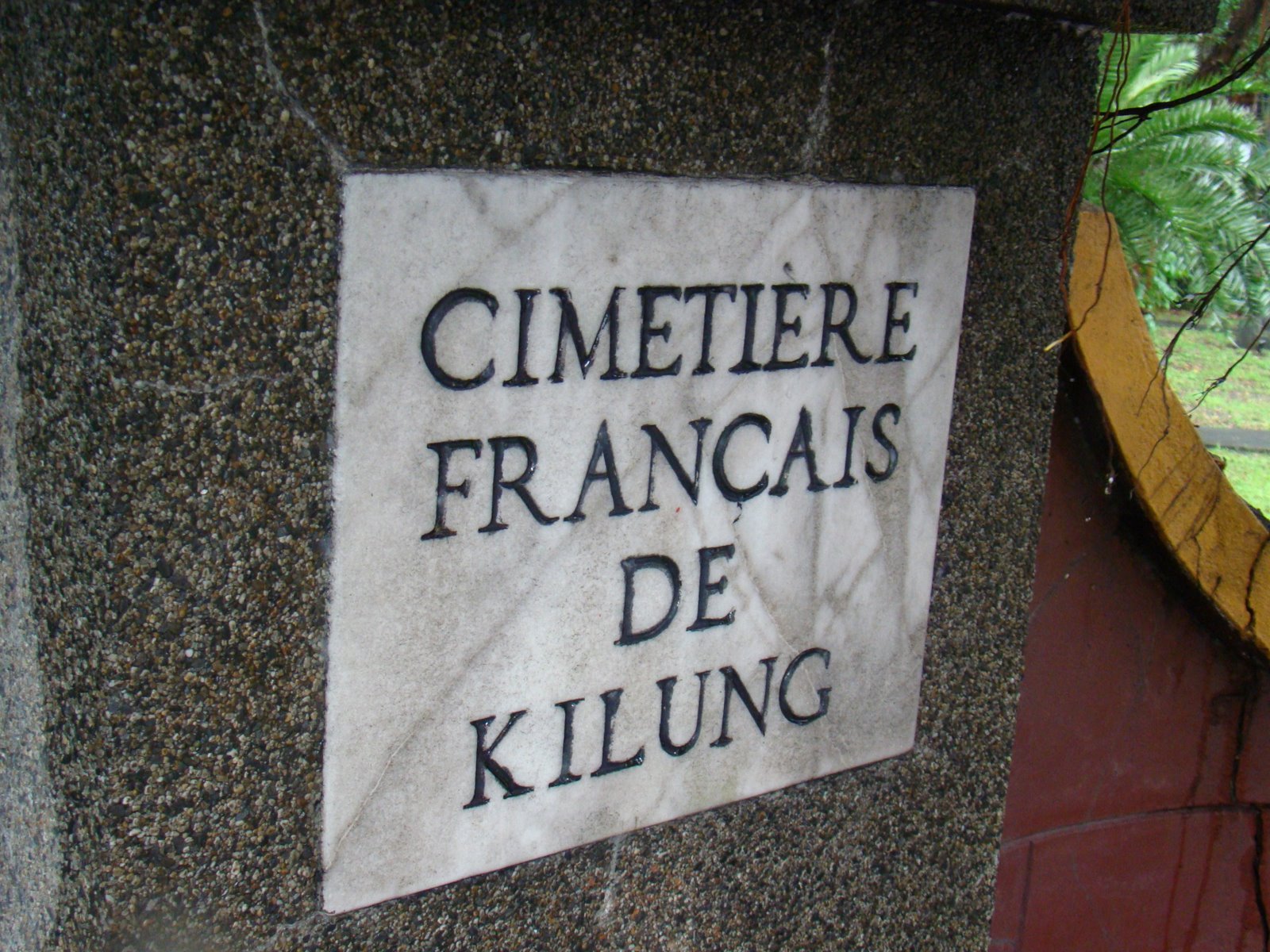
Alexander Frater was based in 紅毛城the Red Fort [Fort San Domingo] in Danshui. The above was just one of his numerous reports. All the major end-games are described in detail in this dispatch: Danshui Harbor pilot Bentley (aka Carozzi) finally went back home to England; all the mines were cleared from Danshui; Dr Mackay was seeking, and eventually received, compensation for his losses; the French departed from Peng-hu; and the warship Wan Nin Ching was in service again. The vandalized French Cemetery in Keelung (image at top) was not kept up until after the Japanese colonized Taiwan in 1895.

[Source of Frater's reports kindly provided by Patrick Cowsill].

2009年7月8日 星期三

More on Carozzi/Bentley

(Left: A view of Danshui with Mt Ta-Tuen in the background. To the left is Ft San Domingo; to the right, the customs office and the ship docking area.)

The following is from Simon (communicated through our friend Mr Patrick Cowsill), an expert on John Dodd and Jardine Matheson:

"I am not convinced Bentley worked for anyone.

1) The Imperial Chinese Maritime Customs was founded as agency that would collect import duties from international shipping and use them to pay indemnities owed to the great powers by the Chinese government. It was staffed and organized by foreigners to ensure a smooth flow of cash as previous ventures relying on Chinese management were plagued by corruption. There's a book in the NCCU library about foreigners in Shanghai that discusses the organization in depth.

The organization was not using foreigners because of 'Chinese ignorance of navigation'. By this stage the Chinese already had several domestically oriented steamship lines...and besides a failure to organize navigation would have greatly inhibited foreigners from plying their trade inland from the coast. Something that one would assume to be appealing to the Qing.

2) The hiring of foreign experts by the Qing was a very common practice. For example, JM supplied the engineers for the Liu Ming-quan's railroad. The Huwei Fort north of ft. Santo Domingo was built by French or German engineers...etc., etc.

Bentley may well have been used in organizing the defense of Tamshui. He was employed by the Chinese government...through the ICMC...so there is no reason to think he wouldn't be involved.

That said, Bentley - as a British / Italian national - would have been expected to not act in a manner that would conflict with his own nation's interest. In working for the ICMC he would certainly been more than a tradesman, though likely not a member of the aristocracy (or even Gentry). WA Pickering was hugely touchy about the 'honor' thing and did essentially the same job as Bentley.

One would assume that in the Victorian era this would have implied a degree of loyalty to one's employer. This, I suppose, lends credibility to the idea that he was in fact working for someone. But there is more...

3) British commercial interests in Tamshui were seriously threatened by French actions. This is very clear in Dodd's book. There was a high degree of anti-foreign sentiment among locals. They burned all Mackay's churches...and both George and John resisted evacuation to the Cockchafer because of concern for 'property' left unattended. The French actually hit Mackay's schools in the shelling.

Moreover, in the China trade, the great power's were largely divided into two camps...The Russians, Japanese and French were into the idea of carving up China into colonies (or spheres of influence) while the British, Americans and to a lesser degree the Germans consistently advocated for a policy that ensured the stability and survival of Imperial China - coupled with open ports and free trade.

The French attack on Taiwan, then, stands in stark contrast to the prevailing British policy of the period. I believe this makes it highly unlikely he was working for either a British company (like Jardines) or the British Foreign Office.

4) I think it is important here to consider the 'Tidewaiter' role. The dudes who did the job: Pickering, Tait and Bentley...were not white trash (exactly) but nor were they successful financially. They were working for salaries in an environment that saw others make and loose huge fortunes. It was a stepping stone. Pickering went on to some government post in Singapore, Tait eventually founded Tait and company...Bentley...well maybe he decided to make his score selling info to the French...and for a large sum by the looks of it.

My guess is that he was acting of his own accord. There certainly was little reason for him to stay on in the employ fo the ICMC...where he was fair game as an enemy combatant (the french shelled his Tamshui quarters). The only question that really bugs me is why the name change? My guess is that while his abandoning post was certainly not a betrayal of the British national interest...it certainly would not have been something that was viewed favorably socially. Maybe he was just doing the whole pseudonym internet comment thing..."

2009年4月18日 星期六

Robert Swinhoe - first British Consul based in Danshui

[Left: Robert Swinhoe 1836 - 1877]

Robert Swinhoe was born in Calcutta, India. He was a naturalist and a diplomat. He arrived in 1854 in Hongkong to learn Chinese languages after passing the British Consular exam.

In 1858 HMS Inflexible sailed from Amoy to Taiwan, with Swinhoe as interpreter. They explored the entire coast, and penetrated considerable distances inland. Swinhoe made important collections of animals and plants.

After serving briefly as interpreter for the 2nd Division of the allied forces in northern China under Major Garnet Wolseley and (later) Commander-In-Chief Sir Hope Grant in 1860, Swinhoe was appointed the first British consular official in Formosa in 1860 at age 24. He traveled to Formosa aboard the gunboat Cockchafer and arrived in Takao with an assistant, George Braun, and a retinue of Chinese servants in early 1861. They then trekked overland to Taiwanfoo, where he set up an acting consulate in Funshin temple outside the city walls. Although Swinhoe was only a vice-consul, he conferred upon himself the title of “brevet rank of acting consul” in order to gain the respect of the local intendant, and eventually managed to secure a house inside the city walls in which he officially opened the consulate on 10 July 1861. Shortly after he moved the consulate to Tamsui in order to encourage trade in late 1861. For the next year the British consulate was based on the SS Adventure, moored in the Tamsui (Danshui) River, after which it was moved to San Domingo, the old Spanish fort in Tamsui:
Swinhoe fell ill and returned to England on sick leave on 10 May 1862 and returned to Taiwan in 1864. He remained active professionally until 1873 when he suffered the first of a series of strokes. He died in 1877, at age 41.

(Source: http://ringmar.net/europeanfury/?page_id=1188)

2013年1月10日 星期四

VOC in Tamsui

[Above: Trade routes of the VOC]

It is well-known that the Dutch East India Company (VOC) settled in Tainan area after its attempt to dislodge the Portuguese from Macau had failed. And its turf war with the Spaniards raged on, even in Taiwan. The Dutch eventually took over both Keelung and Tamsui from the Spaniards in 1642, and went on to build, in Tamsui, Ft Anthonio (the now Red Fort, Ft San Domingo), set up residences, intermarry with, and also fight against the Aborigines. And to support the garrison force in Keelung, instead of shipping supplies in from Tainan, the VOC had acquired farmland north of Tamsui, irrigated by a small stream with clean water, and contracted out the land to the locals to grow food. This river, known as the [Dutch East India] Company Field Creek (公司田溪), still flows today. It empties into the sea in Shalun沙崙 area [on the upper left corner of the hand-drawn map below (click to enlarge)].

[Map of Tamsui by an unknown maker, apparently a Tamsui-lang]

This sparsely populated area is in fact quite rich in history. In addition to the presence of the Dutch East India Co, it was also where the Battle of Fisherman's Wharf during the Sino-French War was fought. And both Chinese and French war dead, the latter including Lt Fontaine, were also buried here.

History, however, will soon intermingle with the new. Not only Shalun, further north, the New Tamhai City 淡海新市鎮 has long been under development, and is still a work in progress, slowed by the lack of a good public transportation system.

In 5 years, however, there will be the Tamsui Trolleys running the Green Mountain Line (7.34 km) and the Blue Sea Line (7.86km) as an extension of the Taipei Metro:
 
淡水捷運輕軌延伸規劃路線有二:

 一是綠山線,由捷運紅樹林站沿中正東路、淡金公路往北,至濱海路往西,於沙崙路轉往北至新市六路路口,路線長約7.34公里。

第二是藍海線,起於中山路與中正路之分隔島,中山路與中正路各布設平面單軌,至新生街與中山路交會後併為雙軌,並沿臺2乙線往西至沙崙海水浴場淡海路右轉,經11號計畫道路跨公司田溪後再右轉,沿濱海路至沙崙路口後,往北與綠山線共軌,路線長約7.86公里,其中與綠山線共軌部分約為1.21公里。

And in graphic form:

The Green Line will eventually extend north into 淡海新市鎮 (in the general vicinity of the St John University in the diagram above, northwest of "downtown" Tamsui) designed to accommodate 300,000 and yet only 11,000 or so souls have moved in so far. With the trolley lines completed, this somewhat delayed yet still a newly minted city will see a real estate boom. And with it or long before, we hope an increasing effort in the preservation of historical sites.


2014年12月23日 星期二

Tamsui landmarks 1935

This was a bird's eye view map of Tamsui made in 1935, 2 years before the 2nd Sino-Japanese war (1937-45), when Tamsui was still a thriving seaport:
A pseudo-3D map of Tamsui looking from the mouth of Tamsui River

A cropped version is shown above. Major landmarks: from Sha-lun Beach (bottom left), going up and right to Hobe Gun Fort/Tamsui Golf course, and next to it, Ft San Domingo/British Consulate. And along the whole stretch of now Chung Cheng Road, various shipping companies, gov't agencies and town offices. All the schools, from elementary school to college, together with the Public Meeting Hall 公會堂 can also be seen. Notice the long-vanished delta was still there.

Also found on the map were rural areas where watermelon (most important summer crop at that time), rice (probably the native 在來 strain), and oranges (the famed bucket oranges 桶柑) were produced.