2015年3月7日 星期六

大米七 (Gros Michel) banana et al

Taiwan has been an exporter of bananas, especially to Japan, since 1902. The golden era, however, truly started in 1963 when Japan instituted a quota-free banana import system, the banana enterprise in  Taiwan reached its zenith in 1967 with more than 52,000 hectares of farmlands producing 653,800 tons of bananas. And of which, 394,966 tons were shipped to Japan directly, taking a 90% share of this market. Unfortunately, it was soon out-competed by bananas from the Philippines cultivated by multinational conglomerates from middle and south Americas. Within 10 years, Taiwan's banana business went into a free fall which was further exacerbated by scandals and mismanagement at the Taiwan Fresh Fruits Co-op, plus the untimely fungal blights that had also severely reduced the output. There have been no significant recoveries since, for example, in 2005, Taiwan's market share in Japan was down to a mere 3%. It remains a major fruit crop in Taiwan nonetheless.

Gros Michel, can still be found in, e.g., Jamaica
大米七 (Gros Michel) banana is no longer available in Taiwan, having succumbed to Panama wilt fungus disease* in the 1960s (*a scourge still spreading world-wide). Now we have 北蕉northern and its sub-strain fairy仙人蕉 bananas instead (both derived from the 華蕉 Cavendish strain):

Three "fingers" of 北蕉 exported to Japan
Unfortunately, the Black Sigatoka (or yellow leaf) Disease and another Panama fungus (Foc Tropical Race 4) are threatening the survival of this strain of banana as well. To avert a potential disaster, the Taiwan Banana Research Institute has developed the following new strains:

1. TaiJiao No 1 台蕉一號 (1992) - resistant to the yellow leaf disease (YLD)
2. TaiJiao No 2 台蕉二號 (aka Barbados dwarf Cavendish BF) (1995) - shorter hence lower wind damages
3. TaiJiao No 3 台蕉三號 (aka TC1-229) (2000) - mid- to short-strain, also resistant to YLD
4. BaoDao 寶島蕉 (aka 新北蕉) (2001) - high yield, resistant to YLD
5. TaiJiao No 5 台蕉五號 (from TaiJiao No 3, aka 玉山 and TC3 1035) (2007) - highly disease resistance
A "hand" of TaiJiao No 5
6. TaiJiao No 6 台蕉六號 (aka 玉豐 Cavendish BF) (2007) - high yield
TaiJiao No 6

Which one(s), or even some of those yet to be developed, will survive in the long run is still being worked on, by very capable researchers no less. Rest be assured, though, that we will always have bananas to enjoy, as there are more than 300 strains of bananas on this earth. Cavendish is merely one of them, just happens to be the most popular one at present time.

Factoids: (1) Banana 香蕉 is pronounced 芎蕉 in Taiwanese. 芎 is derived from 弓 as the "bow" in "bow and arrow". A banana shapes like a bow, hence the name 芎蕉. (2) A 香蕉芎 is a "hand of bananas" in English, and each banana is a "finger".  A "bunch" of bananas refers to, technically, the whole "six foot, seven foot, eight foot bunch" (Harry Belafonte - Day O).

2015年3月5日 星期四

Passion fruit

Passion fruit, so named, not because of some emotional attachments, rather it was because its flower looks like the crown of thorns worn by Jesus Christ and also the petals signified the 12 Disciples, i.e., it derived from the "Passion" of Jesus (according to Spanish priests who found the plant in S America in ca 1610). The Japanese, however, called the flower 時計草 (とけいそう) or clock-dial flower because of the resemblance.

Passion Fruit cultivars entered Taiwan between 1901-07 from Ishikawa Botanical Garden in Japan, originally a Brazilian species. The fruit has multiple names and each one has a special meaning,

(1) 時鐘果, the most common Taiwanese name before 1960, derived from 時計草:

This is the dark purple type, never widely cultivated since the introduction into Taiwan and was left to grow on its own in mountain areas under 1,000 meters altitude, and grew wild it did, complete with various snakes sheltered under its shades. This fruit was once available in Tamsui, sold at roadside stands together with 彈珠汽水 (ラムネ, marble-sealed bottled soda) and other summertime treats.


(2) 百香果 or 100-fragrance fruit:

So called allegedly because its juice tastes like a combination of banana, pineapple, lemon, strawberry, star fruit, and guava, etc. Also, 百香BaiHsiang maybe a phonetic translation of "passion". A more credible theory, however, is that in 1960, Taiwan Pineapple Corp started marketing canned passion fruit juice labeled 百香果汁, and the name stuck.

(3) 西番蓮 is a botanical classification term. And 西番果 is used in China and Hongkong. 西番 means Western Savages.  

In 1964, yellow-skinned passion fruit cultivars were imported from the Pan-Pacific Farms in Hawaii, and in 1967, even more from S America. They were harvested mostly for juice extraction. The juice was then sold back to the US to be canned and distributed to its military (according to one report). The yellow strain is not cold-tolerant that must be grown under 500 meters altitude. Also, time-consuming artificial pollination must be done to achieve fruition.


Now a hybrid strain 台農一號 TaiNong No 1, developed in 1975 by Feng-Shan Agricultural Experimental Station, has replaced the parental yellow and purple strains and becomes the main passion fruit crop in Taiwan:

At present, the cultivation area is only about 200 hectares scattered in Nantou and Hualien areas, and because of a viral plight, it is necessary to re-plant the vines every year.

Unlike the ubiquitous banana, watermelon and pineapple, passion fruits are still there in Taiwan, just have to search a bit harder for them.

2015年3月1日 星期日

Taiwan grapes

Red-faced muscovies guarding grapes

Grapes had never hit it big in Taiwan in the past. For years, private wine-making including that with grapes, was against the monopoly law which carried severe penalties. Native grapes were also tiny and sour, unfit for table use. No grapes, no problems, other fruits abounded anyway. These have all changed in the 1960s. Since then, we have 巨峰 (Kyoho or ChuFeng), 義大利 (ltalia), 金香 (Golden Muscat), and 蜜紅 (Honey Red) varieties, among them, the huge, juicy and sweet Kyoho is arguably the most abundant and the best-tasting table grapes all around.

Italia
Golden muscat

Kyoho was first developed in Japan in 1935, a cross between the native Ishihara-wase and the Centennial from Australia. The exact date of its introduction into Taiwan is unclear; although 2 of the first 6 seedlings planted in 1964 in Changhua 大村Da-chun by Mr 賴炳芳 have survived to this day, and in fact are still going strong.

巨峰葡萄 - Kyoho grapes (with the protective paper bags removed for photography)
Kyoho is cultivated mainly in Changhua, Taichung and Nantou, totaling 3,000 hectares. It is harvested twice yearly, in contrast to only once a year in its native Japan. Not only the soil and weather conditions are both right, the credits should also go to the skilled Taiwanese grape farmers for their careful pruning, fertilizing and nurturing of the plants. And of course, consumers do appreciate a good thing when they see one, and the demand has skyrocketed.

Curiously, China, known for hundreds of different types of grapes available from Xinjiang (grown in 吐鲁番Turpan area on the Silk Road), also started growing Japanese Kyoho in 1959. It remains somewhat murky as to how the cultivars were procured. We do know that starting in 1996 or a bit later, Taiwanese merchants brought the Taiwanese strain to Hainan and the transplant proved a huge success. Their Kyoho is now in direct market competition with Taiwan.

Honey Red was introduced in mid-1980s from Japan by Prof 楊耀祥 of National Chung Hsin University. Its taste and texture both have received favorable reviews. Planting is, however, limited to around 70 hectares. It is still awaiting further improvement in the rupture, storage and shipping departments. This is a work in progress; although it will soon become the next Kyoho, most certainly worthy of a try even now:

蜜紅 (Honey Red) grapes shielded from the sun
To order your own shipment of Kyoho grapes, go to this site (here) and for the Honey Red, here.

2015年2月25日 星期三

Pineapple Kingdom Part 2

By 1935, 40 years into the Japanese Colonial rule, Taiwan already had 54 companies with 78 factories producing canned pineapples. Then the 台湾合同鳳梨株式会社Formosan Consolidated Pineapple Corp, Ltd, took over. A rare photo of its Takao [Kaohsiung] plant assembly lines is shown below:

Taken on July 5, 1938
It can be seen that most workers were women with a few young men mixed in [in fact, 101 women and 16 men at this plant]. Ladies wore white caps and aprons and boys, white shirts and short pants. With rubber gloves on, they stood and worked on both sides of the assembly lines. The design of this Kaohsiung plant was copied from that in Hawaii, then the world's biggest canned pineapple producer. It emanated a sense of cleanliness and efficiency. Each assembly line worked at a pace of 50 cans per minute, and the factory total output was 56,000 cans on each 10-hour workday. It was also a showcase, a must-see sight for VIPs visiting from Japan.

Sun-shade, a product of 台湾合同鳳梨株式会社
F.P., another of 台湾合同鳳梨株式会社
The 台湾合同鳳梨株式会社 was created in June, 1935, by the Japanese Colonial Gov't, essentially a monopoly, which bought out 53 existing producers and consolidated their operations. In conjunction with factories affiliated with 東洋製缶株式会社Toyo Packing Corp, Ltd, large-scale production soon commenced in 36 plants (streamlined from the original 78). This buy-out was not without Taiwanese resistance, however. The 大甲鳳梨缶詰商会Taiko Pineapple Packing Business Assoc with 60 workers, headed by Mr 許天徳, remained independent. And in October, 1935, 許's company became the Taiwanese-owned 大同拓殖Datong Takushoku after relocating to 石垣島Ishigaki in Okinawa, and stayed active in pineapple growing and canning. [Note: to escape being absorbed into gov't monopolies, Taiwanese businessmen often moved off-shore to Canton, Hainan, or Okinawa, outside the sphere of influence of the Japanese Colonial Gov't.] Further, because of the high profitability, underground manufacturing and shipping (to China and Japan) also continued unabated.

Canned pineapple packed by Taiko 大甲 - Pine is shorthand for pineapple
The demand for war materiel during the Pacific War, especially metal, had put an end to canning of anything in Taiwan, including pineapple. Canned pineapple production did resume after the war reaching a height in 1971 (see Part 1).

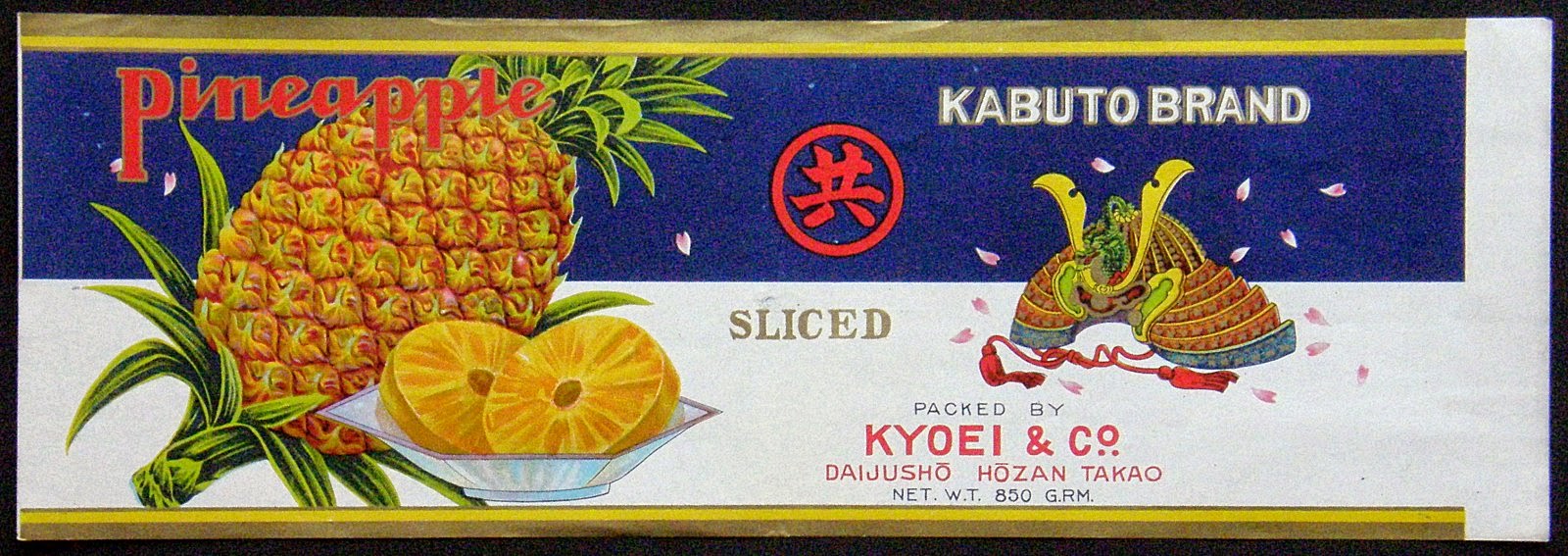
TaipeiMarc of Taipics.com has kindly provided vintage labels of canned pineapples shown above with more below:
新高山Niitakayama by Sakamaki & Co, based in Taipei
Sokei-bijin (double-chicken beauty) brand, packed in Changhua
Kabuto, produced in Kaohsiung


Aboriginal Brand made in Feng-Shan 

This post is based on a paper by 北村嘉恵, 『境界研究』特別号 (2013), pp 133-139 (here)

2015年2月21日 星期六

Pineapple Kingdom Part 1

Sunny Hills pineapple cakes, made with real pineapple
It is fairly well known that the famed 鳳梨酥, pineapple cake, in Taiwan is made with winter melon fillings, not a trace of pineapple inside. Vendors claim that this has always been the preference of the consumers. That may be, but why not just call it winter melon cake a la truth in advertising? Even more puzzling is the abundance of pineapples in Taiwan that, inexplicably, has not been taken advantage of. Fortunately, some vendors have finally seen the light and begun to produce bona fide pineapple cakes (e.g., Sunny Hills), much to the delight of (some) foodies world-wide.

Pineapple harvesting, ca 1971
Pineapple is not indigenous to Taiwan. Presumably, it was native to South America and the Europeans brought it back to the Old World, etc, etc. In any case, it has found its way from China to Taiwan during the reign of emperor Kang-Xi康熙. The Japanese colonial era saw the industrialization of pineapple production; it was when Taiwan began to export canned pineapples - until interrupted by the Pacific War. After the war, through various promotion schemes, 1971 marked the highest point of pineapple cultivation expanding to more than 16,000 hectares in southern Taiwan. It was also when Taiwan became the world's largest exporter of canned pineapples, shipping out a total of 4 million plus commercial crates. Competition from SE Asian nations, however, has greatly reduced Taiwan's market share; although domestic consumption still remains strong.

Through the tireless efforts of folks at Taiwan Agricultural Experimentation Station (台灣農業試驗所), R&D of the cultivars has yielded numerous new strains, among the major ones are 台農 Nos 1 to 20, each with a popular nickname. In comparison, pineapples in Hawaii come in a mere 2 strains, MD-1 and MD-2. In the Pineapple Kingdom, Taiwan, a pineapple is not just a pineapple, even though they all look the same.

Since pineapples typically take 1.5 years to reach maturity and each strain has a distinct planting season, pineapples can be enjoyed year round. Here is a short list with nicknames and the best in-season time for consumption as a table fruit:

KaiYing Strain No 1 (開英種一號) for canning purposes
KaiYing Strain No 2 (開英種三號 or 土鳳梨) the "native" strain
TaiNong No 4 (台農四號, aka Sugar-apple Pineapple 釋迦鳳梨) mostly for exports, best time to consume: from February to April
TaiNong No 6 (台農六號, aka Apple Pineapple 蘋果鳳梨) the most popular on the wet market, best season: from April to June
TaiNong No 6 - Apple Pineapple
TaiNong No 11 (台農十一號, aka Perfume Pineapple 香水鳳梨, best: May-June
TaiNong No 13 (台農十三號, aka Sugarcane Pineapple 甘蔗鳳梨) fall-winter production
TaiNong No 16 (台農十六號, aka Sweet-honey Pineapple 甜蜜蜜), March-October
TaiNong No 17 (台農十七號, aka Golden-diamond Pineapple 金鑽鳳梨, Feb-May and Oct-Nov
TaiNong No 18 (台農十八號, aka Golden-osmanthus Pineapple 金桂花), April-July
TaiNong No 19 (台農十九號, aka Honey-treasure Pineapple 蜜寶鳳梨)
TaiNong No 19
Wedges dipped in salt water can reduce the pineapple "sting"
How to pick the right pineapple to purchase? As lard-making, this is also a skill requisite of all Taiwanese housewives, essentially the same diagnostic technique used by practitioners of Traditional Chinese Medicine, i.e., judgment based on weight, shape, color, smell, and sound (when tapped with fingers).

Factoid: Pineapple 鳳梨 is pronounced 旺梨 ong-lai in Taiwanese, the same as 旺來, meaning "prosperity arriving". They are often given to friends as a wish for good luck.

2015年2月17日 星期二

Watermelon of Taiwan

The 1935 map of Tamsui (here) has marked where watermelon were cultivated, for example, a patch near Tamsui Shalun Beach (where clubhouse 和樂園 was located). Planting was in the winter, in time for summer harvests. Most locals recall basketball-sized watermelon with dark green exterior and crimson red flesh. Usually slices are chilled on ice, and salt grains sprinkled onto them immediately before consumption. The slight saltiness in fact intensifies the sweetness. Simply heavenly, needless to say.

Large-scale farming of watermelon in Taiwan actually started in 1717, introduced by migrants from Hokkien, the latter at the invitation of the Ming-Cheng dynasty (1662-1683). The varieties have since increased in leaps and bounds. Some of them are shown below:

Source: http://book.tndais.gov.tw/Other/2013watermelon/speech1.pdf
Above: Taiwan watermelon by the decades: (A) 富光FuGuang and (B) 鳳山一號Feng-shan No 1 seedless watermelon, both of the 1960s; (C) 金蘭Golden Orchid, the first to win an All-America Selection Prize, and (D) 新小鳳New Little Phoenix both developed in the 1970s;(E) 特小鳳Special Little Phoenix and (F) 鳳光FengGuang, both of the 1980s;(G) 黑美人Black Beauty, (H) 秀玲HsiuLing, and (I) 黛安娜Diana all developed in the 1990s;and (J) 甜美人Sweet Beauty, in the 2000s.

The acreage of watermelon growth has increased from 1,500 before 1950 to a peak of 36,257 hectares in mid-1980, now down to 11,715 hectares, still quite sizable. And the cultivation fields have shifted from the initial mid-Taiwan, to southern, now to eastern Taiwan.

瓜子- some skills are needed to extract
the "meat" inside each seed
There are four categories of watermelon crops, (1) regular, (2) miniature, (3) seedless, and (4) seeded. Among them, (4) was grown specifically for seeds, from which the 瓜子 snack is made; unfortunately, this category has been wiped out by cheap products from China, it is no longer in production.

There is also no such thing as a pure watermelon vine. Watermelon is grown from twigs grafted onto roots of other vines such as 蒲瓜 (hulu), winter melon, 絲瓜 (loofah). and pumpkin. And the rumor that yellow-fleshed watermelon is the original strain which was overwhelmed by the red-fleshed ones appears an urban legend.

Currently, the most popular regular-sized red-fleshed watermelon is 華寶HuaBao.

Little known factoid: The best-tasting watermelon is in a state of Shua (沙)(Taiwanese, meaning sandiness) ripeness. Over-ripen watermelon has started to ferment and the flesh would become disturbingly soggy.

2015年2月8日 星期日

Special Forces Part 4 - The Cafres

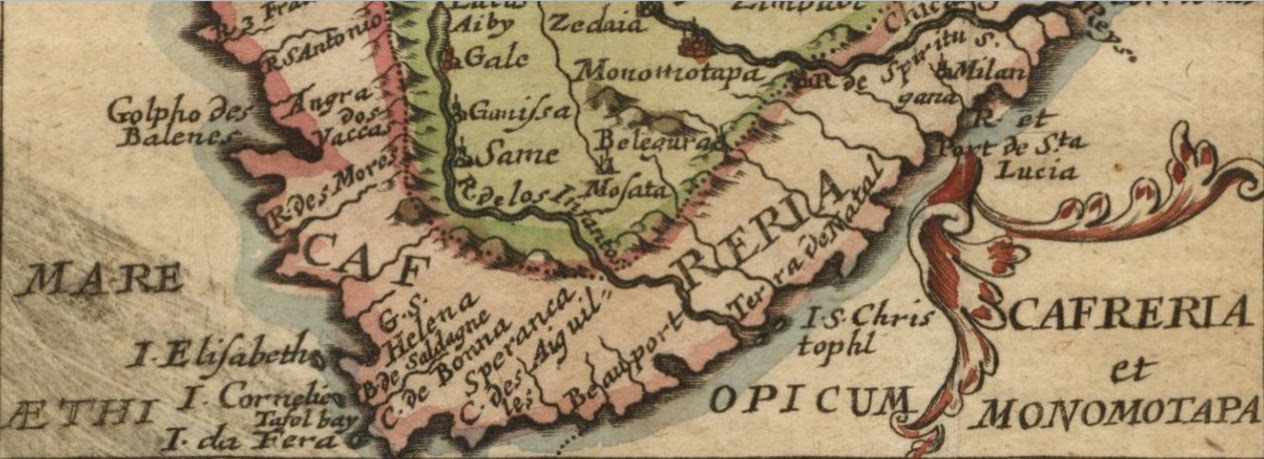
Above: Details of a map published in 1679 in Nuremberg showing Cafreria, the homeland of the Cafres. The geographic location matches the southern portion of present-day South Africa plus part of southern Namibia. To its north was Monomotapa. [Note: around 1420, 鄭和Cheng He and his fleet visited Monomotapa and were well received by the royal court. Among the gifts from Cheng to the kingdom were horses and gunpowder. Some folks there later became experts of gunpowder-powered firearms.]

It remains a great mystery as to what happened to the Cafres, the Black Rifle battalion, after the fall of Ming-Cheng Tung-Ning Kingdom in 1683. They had previously served both Koxinga's father 鄭芝龍 and Koxinga himself well in combats and as personal/palace guards.

The last known action of the Cafres was to follow Lady Tung's order and execute Cheng Jing's illegitimate son Cheng Ke-Chang to make way for the younger, lineage-based heir-apparent Cheng Ke-Shuang. This would have occurred near the end of the Tung-Ning era (ca 1682-3).

Lady Tung's residence (now 開元寺) where Cheng Ke-Chang was summoned to
and assassinated en route
It is highly doubtful that the Cafres were allowed to stay in Taiwan since all Ming-Cheng soldiers were forced to penal colonies in China. It is also equally doubtful that they were repatriated back to Cafreria as freemen, if ever. Assimilation into the general population remains a possibility since some had married Han women; although this is yet to be verified.

Possibly a Cafre in a temple in Tainan