2013年7月31日 星期三

Tainan Airfield(s) 1944-45 Part 2

“20 Oct 1944 – United States Army Troops with General DOUGLAS MAC ARTHUR in personal command, land on LEYTE ISLAND in the PHILIPPINES.”
"I shall return" and he did.

To prepare for this glorious MacArthur event, however, incessant US bombing of Taiwan started in earnest on 12 October 1944.

In the early days of the Pacific War, the Japanese High Command had decided to make Taiwan a formidable fortress and transform it into an aptly named "Unsinkable Aircraft Carrier". It was estimated that 71 airbases had been reinforced or constructed since then. Initially, some were intended for civilian use, for example, the Tainan Airfield (Eikosho) was built in 1937, drafted by the IJA Air Force in 1943 as were many other civilian airports. [Note: The seaplane port in Tamsui became an IJN base at around the same time.]

From the strategic POV of the US High Command, this Unsinkable Carrier must be sunk at all costs, not only to neutralize the Japanese offensive capabilities but also to clear the way to mainland Japan. The invasion into Taiwan area spearheaded by US Naval Task Force 38 of the Third Fleet, aided by the US Army Air Force, can be found in this book:
The Army Air Forces in World War II, Volume Five: THE PACIFIC: MATTERHORN TO NAGASAKI JUNE 1944 TO AUGUST 1945 - available online [here].

As far as the bombing of Tainan Airfield(s), we will use the declassified history of the 40th Group under the XX [i.e., 20th] US Army Air Force Command, one of the several bombing groups involved, as an example:

HEADQUARTERS 40TH BOMBARDMENT GROUP 
Office of the Historical Officer
APO Number 631
20 November 1944
Group History: 1 Oct to 31 Oct 1944
Prepared by WILLIAM M. MC NAIR, Captain, Air Corps, Actg Historical Officer

[Excerpts]

"It was decided that combat B-29’s should carry bombs rather than gasoline over the hump as XX Bomber Command now had a fleet of C-109 tankers carrying gasoline to the forward area. On 2 October some of the newer B-29’s with center wing tanks were dispatched to China with a load of 40 x 500 pound bombs in each airplane. The trip was accomplished without any unusual occurrences.[Note: this group was based in India, mobilized to Chengdu, China by flying over the Himalayas ("the hump").]

"On 9 October, the 40th Group began dispatching aircraft to China for the first of three missions scheduled for October. The target was the OKAYAMA airfield and arsenal at OKAYAMA, FORMOSA [Note: this was 岡山], called by the 20th Air Force as “the most important target south of Japan.”

“Starting at 132256Z on 14 October 1944 all 34 aircraft were airborne to attack the OKAYAMA airfield and arsenal at OKAYAMA, FORMOSA. By 132338Z 32 aircraft had been airborne, the remaining two being delayed, one by mechanical difficulties and the other becoming mired when it taxied off the runway. Both difficulties were overcome and the last aircraft was airborne at 140117Z.

“A total of 473,500 lb An-M 64 TNT bombs with .1 sec nose and .01 sec tail fusing and 236,500 lb AN-M 76 type incendiary bombs with instantaneous nose and non-delay tail fusing were dropped on the primary target.

"At the completion of the mission the Group did not return to India, but awaited further order in China and they came the next day. Another strike was to be made, this time a maximum effort against Japanese installations at EINANSHO airfield and repair depot at TAIWAN, FORMOSA. The assigned secondary target was shipping harbor installations at TAKAO, FORMOSA. This was to be a special mission by 40th Group airplanes, on 17 October, as planes from the other Groups had flown a mission on 16 October.

“A total of 32 B-29 aircraft at A-1 were considered available for the mission. Starting at 16230Z 30 aircraft were airborne with the last aircraft taking off at 170015Z. Two aircraft were unable to take off due to mechanical difficulties.

“Of the 30 aircraft airborne 10 attacked the assigned primary target dropping a total of 174 GP and 50 incendiary bombs from 24,000 feet with reported good results. Weather over primary target was such that the target was covered by cloud from the east up to the extreme western edge. The target was clearly visible coming in from the west and bombs were seen to explode in the aiming point area. No worthwhile photos were obtained due to cloud cover.

“Between 12 and 14 enemy S/E fighters were sighted below the formation but attacks were not pressed home in this area. Antiaircraft fire was meager and inaccurate. Several aircraft reported sighting high altitude balloons, spherical in shape with a long black box-like object suspended beneath them. The balloons were reported at 23,000 feet and it is believed photos were obtained.

“Thirteen aircraft proceeded to the primary target but finding it cloud covered went on to the secondary target and dropped a total of 281 GP and 121 incendiary bombs from 24,000 feet with good results. Approximately 15 ships, six of which were large ocean going type, we re found in the harbor. The center of the main bomb pattern appears from strike photos to have hit in the midst of the anchored shipping slightly short of the assigned aiming point. Three or more ships appear to have sustained direct hits and there are apparently numerous near misses. Some bombs are seen to be striking the main northern dock area. Weather was CAVU,

After accomplishing the missions in Taiwan, Group 40 was dispatched to attack Japan:

“Starting at 241828Z a total of 14 aircraft were airborne to attack the OMURA Aircraft Plant at OMURA, JAPAN [Note: This was 大村 in Nagasaki].

[Note: More information on the operation of  Group 40 also can be found in this excellent post: http://taiwanairpower.org/blog/?p=4178]

Group 40 Bombardment Group was only one of the many that had bombed Taiwan. From November 1944 to February 1945, bombing events without mentioning specific targets were documented in
The United States Air Force: A Chronology

On November 25 1944: B25s, P38s, P51s of the 14th Air Force attacked Formosa Taiwan for the first time
In 1945:
January 17: 91 B29s of the XX Group attacked Hsinchuku, the last mission from Chengdu
January 22: B24s and P38s from the 5th Air Force attacked Formosa, their first mission
February 19: The 14th Air Force hit Formosa with B24s, B25s, and P40s

Then from 1 March 1945 on, a long list of sorties against "Tainan Airfield" and the town of Tainan:
Loading bombs onto a B24 Liberator
American missions against Tainan Airfield
March 1 - July 10, 1945
March 1, 1945
(FEAF [Note: Far East Air Force]) B-24s bomb the Takao aluminum plant, Tainan Airfield
March 3, 1945
(FEAF) B-24s pound the Tainan area
March 12, 1945
(FEAF) On Formosa B-24s, with P-38 support bomb Takao and Tainan. P-51s also hit Tainan
March 18, 1945
(FEAF) Aircraft hit Tainan Airfield
March 20, 1945
(FEAF) B-24s bomb the town of Tainan
March 22, 1945
(FEAF) B-24s hit Tainan
March 28, 1945
(FEAF) B-24s hit Tainan
April 8, 1945
(FEAF) B-24s and B-25s hit Tainan
April 12, 1945
(FEAF) B-24s attack Tainan
April 13, 1945
(FEAF) B-24s hit Tainan Airfield
April 18, 1945
(FEAF) B-24s hit Tainan Airfield
April 19, 1945
(FEAF) B-24s hit Tainan Airfield
April 20, 1945
(FEAF) B-24s hit Tainan Airfield
April 24, 1945
(FEAF) B-24s hit Tainan
April 30, 1945
(FEAF) B-24s hit Tainan
May 18, 1945
(FEAF) B-24s hit Tainan Airfield
May 18, 1945
(FEAF) Fighters sweep the Tainan area
May 29, 1945
(FEAF) B-25s, and fighter-bombers, hit the Tainan alcohol plant and targets of opportunity
July 10, 1945
(FEAF) B-24s bomb Tainan Airfield, destroying several planes
The immediate questions are (1) which Airfield and why so many attacks? (2) why target Tainan (City) at all? and (3) what were "targets of opportunity"?

2013年7月29日 星期一

Tainan Airfield(s) 1944-45 Part 1

It took a while to piece together the missing details of the bombing of Tainan Airfield, from 12 Oct 1944 til the end of the Pacific War in 1945. 

Thanks to Prof YangHL who points the way: The paper published by 杜正宇 and 吳建昇, "日治下臺南永康機場的時空記憶", 台灣文獻 Vol 63, Issue 1, Pp 230-284 (2012) has reported that there were actually three Tainan Airfields, located in 永寧庄, 永康庄, and 歸仁庄, respectively. Only one remains today, i.e., the present Tainan Airport, previously known as the 臺南飛行場(永寧庄). The other two have long disappeared, both physically and historically. Now, with the seminal efforts of Prof 洪致文, the above-mentioned paper has reconstructed the history of 臺南飛行場(永康庄), unknown to even natives of Tainan. One of them, Mr WuJM comments: "I did not know there used to have an airfield although I went to Tainan Industrial Tech High in Yong-kang. I traveled on dirt road from near Tainan railroad station to YongKang every day for three years. Of course I was young then."

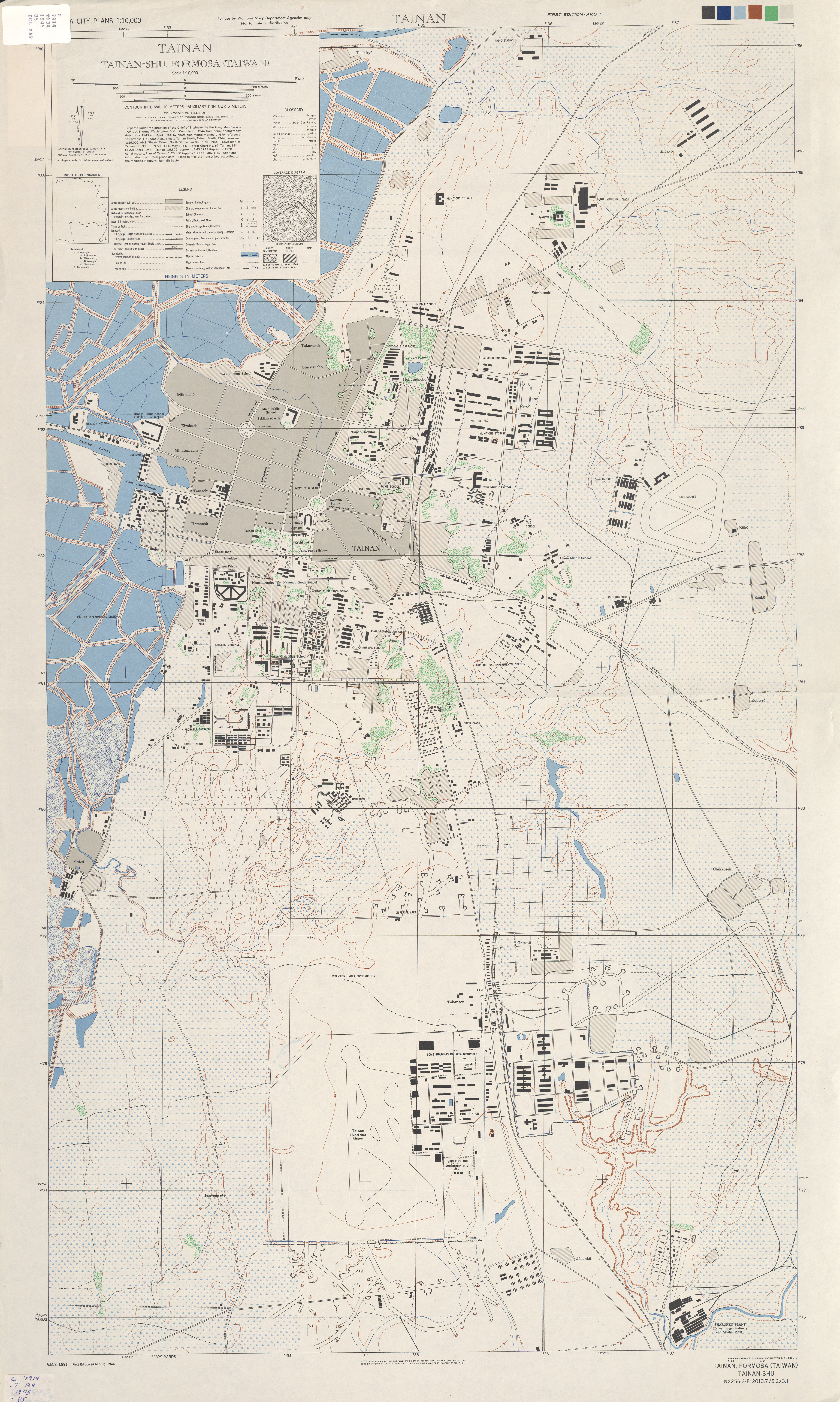
The proper Japanese kan-ji pronunciation of 永寧庄 and 永康庄 is Eineisho and Eikosho, respectively. For unknown reasons, perhaps for disinformation purposes, the former was misspelled as "Einansho" which consistently appeared in all 1944 US military documents. "Einei-sho" is seen only in the 1945 map of Tainan City made by the US Army Map Service (in the Univ of Texas Library map collection)[http://www.lib.utexas.edu/maps/ams/formosa_city_plans/txu-oclc-6565942.jpg]. Both airfields were targeted by the US.

There are multiple confusions: (1) in the US records, "Tainan Airfield" is not necessarily the Einansho Airdrome and Depot, it can be one of the 3 different airbases of the same name; (2) since two of the 3 bases vanished after the war, it was never clear which one(s) the US bombers had hit on each mission; (3) Einansho is actually Eineisho - almost no one could decipher what Einansho was in Japanese kanji; and (4) on at least one occasion, the USAAF had bombed 麻豆飛行場 also in Tainan, mistaking it as the Tainan Airfield (Eiko) because of the proximity and the almost identical runway configuration.

Here is the narrative of a USS Enterprise-based Navy Ensign, Bob Barnes, who piloted a Helldiver in the attack on:

12 October 1944 - Einansho Airfield (Formosa)

Robert J Barnes, then 20 years old on the wing of his Curtis Helldiver
We headed for Formosa (Taiwan) to attack a very large Japanese airfield. We headed in with VB-20 leading the way under CDR Riera and VT-20 and VF-20 for fighter cover. As we got close to the target and ready to peel off for our dive, we heard the fighters on the radio say 7 Zekes (Japanese fighters) were heading to attack. I switched gas tanks to have a full tank and peeled off. On the way down - straight down - I was concentrating on the target, wind, etc., when I heard a tremendous explosion. The plane shook and at first I thought I had forgotten to switch tanks and the empty tank had caused the engine to backfire.

Here I was, in a dive through heavy anti-aircraft fire, with Jap fighters chasing me. I switched tanks again, released the bomb, pulled out and the engine quit. In the meantime, my rear seat aircrewman confirmed we had been hit in the tail by AA. I quickly checked my fuel tanks and then realized I had already switched tanks and in the heat of the moment had switched back to the low tank. After switching back to the full tank, the engine started. What a relief! I headed for our rendezvous for the return to Enterprise. After landing, it was found that the plane had a large hole in the vertical stabilizer from the AA that had hit and bursts which sprayed shrapnel holes all over the rear of the Helldiver.

The defenders had put up a fight and incurred some losses: "On 12 October 1944, when we attacked Formosa, two of our Helldivers flown by LT Sam Tharp and LT(jg) George Muinch were hit by AA but were able to glide out to sea, to be picked up by our good old lifeguard submarines. One of my roommates, ENS Fred Turnbull from VF-20, was shot down that day and taken prisoner. I next saw him at a reunion 45 years later, in Pensacola. That same day, LT(jg) William F. Ross of VT-20 and his crew, Harry Aldro and Charles E. McVay, were shot down and captured. Sadly both crewmen were killed while prisoners. LT(jg) Ross was a prisoner throughout the war. That was one rough day!"

The Oct 12 1944 attack on Taiwan was island-wide, conducted principally by the US Navy with carrier-based aircraft. Bombing with land-based long-range bombers followed two days later and continued well into the early part of 1945.


2013年7月9日 星期二

Tamsui Town History

Tamsui District Office announces the publication of Tamsui Town History淡水鎮志 [quoted from Mayor Tsai Yeh-Wei's Facebook pages of Jul 7 and 9]:


有關「淡水鎮志」索取原則[The availability of Tamsui Town History]:

1. 紙本印刷數量有限,將依慣例,送全國319鄉鎮市公所、重要圖書館(如央圖、本區各學校圖書館...等)。[Limited hard copies will be distributed nationwide as usual to 319 units, including city/town offices, major libraries, and school libraries within Tamsui district.]

2.光碟版500套,供市民索取,送完為止。年底如還有預算再追加。[500 sets of DVDs are available upon request by citizens. Re-supplies will subject to funds available.]

3.已責成本所資訊室同仁,將數位檔案公開,未來市民可在本所網站下載區內自由下載,廣為流傳。[A downloadable digital version will soon be accessible through the District Office website.]

4.淡水鎮志版權歸淡水區公所所有,本著政府資訊公開原則,歡迎大家下載、分享、廣為流傳,但如引用,請註明出處。[This History has been copyrighted by the District Office. The public is welcome to download, share, and distribute. Please include the source in citation.]

感謝淡江大學歷史系、中文系,真理大學宗教系等各位篆稿委員及審稿委員的努力,終於出版。[Thanks are due to the writers and reviewers of Depts of History and Chinese Literature, Tamkang Univ, and Dept of Religion, Aletheia Universities, whose joint efforts have made the publication possible.]


2013年5月12日 星期日

History of Tamsui Seaplane Port


For decades since 1945, no one in Tamsui knew why this small town was twice targeted by the US Navy. Thanks to Mr N Hirokawa who has finally detailed the history of Tamsui Seaplane Port, and with it, the background of the attacks. His original post, written in Japanese, can be seen here: http://www.shipboard.info/blog2/ [published on 5/8/2013]. The following is an edited version:

The aerial photo above was taken on Oct 12, 1945, by one of the 13 F6Fs of the 18th US Navy Corps. They were based on carrier "USS Intrepid (CV-11)" then operating off the southern coasts of Taiwan. Three seaplanes on the ground near the sloping runway can be clearly seen. Another appears on the surface of the water to the left with one more locating in the bunker on the right. It is not possible to distinguish if they were mono- or bi-planes from the photo; although, based on records, they were most likely the reconnaissance monoplanes. The railroads of the Tamsui Line and the two cylindrical-shaped oil storage tanks of the Rising Sun Petroleum Co also are seen.

In 1937, The Aviation Administration of the Colonial Governor General's Office began planning for the construction of a seaplane port at 鼻仔頭, near Tamsui Station. It was built in 1941. The twice-monthly flying-boat ran between Bangkok and mainland Japan, operated by the Great Japan Airlines, had used it as the port of call for refueling. Unfortunately, this civilian airline operation ceased on Dec 12, 1941, when the Pacific War broke out.

Subsequently, Model Zero reconnaissance seaplanes were dispatched from 東港Donggang Air Base in Kaohsiung-shu, and deployed in Tamsui for weather observation and security patrols. The Zero's made water-landing, grazing the sandbar, then in the middle of Tamsui River, in a maneuver known to the town folks as "wearing wooden clogs下駄履き".

The operation of the IJN in the vast Pacific Ocean was often hampered by the paucity of well-maintained air fields. The observation and guidance of the accuracy of shells fired by warships were performed by the Yokohama Air Corps using flying boats and the Donggang Air Corps with seaplanes and reconnaissance aircraft. The Mitsubishi carrier-based Zero's had also been re-deployed in many land air bases. And in addition, when outfitted with pontoons, these Zero's also could fly out of seaplane ports.

The IJN air corps were named after the locations where they were stationed. Initially, there was the Tainan Air Corps with re-deployed carrier Zero's and then the Donggang Air Corps, adding a flying boat unit. As the war progressed with re-assignments to the front lines, for counterintelligence purposes, the corps names were changed. And the Donggang Air Corps was re-designated as the 851st Air Corps.

In March, 1945, crack combat units began to move into Tamsui. The 634th IJN Air Corps that had fought in the Philippines moved into Tamsui with its 24 reconnaissance seaplanes (18 on active duty with 6 in reserve), and 250 troops including the commander, aviators, crew, and ground personnel. Barracks in Shilin had been set-up as well. This Air Corps had carried out bombing missions, scoring direct hits on enemy warships sailing from the Okinawa area. Single-wing reconnaissance seaplanes such as Type "瑞雲auspicious clouds" could actually dive-bomb with the two 60-kg or 250-kg bombs on board.

We the Tamsui-lang now understand the first US attack on Tamsui on October 12, 1944, was a pre-emptive island-wide all-out offensive against the military forces in Taiwan. The main target for the attack on May 31, 1945, was Taipei when Tamsui was also hit, probably as a retaliation for the losses incurred by the 634th Air Corps.

Civilian lives and properties of Tamsui/Taiwan lost to the aerial attacks can never be justified, however.
________________________
Additional sources: http://taiwanairpower.org/blog posts on May 19 and September 15, 2012.


2013年5月3日 星期五

After 193 years

The Koxinga Temple in Penang, Malaysia, finally finds its roots in Taiwan.

To formalize the link-up, a statue of Koxinga, known as 金身, is prepared at the Cheng Family Temple in Tainan in an elaborate ritual, complete with food offering accompanied by traditional music. The process, 分靈 or "spiritual cloning" for lack of a better terminology, is required to authenticate the origin of this statue.


The statue is then officially handed over to Chairman Lim of the Koxiga Temple in Peneng for the journey to Malaysia:

Before boarding
Arriving in Penang
Reception at Koxinga Temple in Penang
Finally, the new statue takes up the rightful place (above), replacing the one lost in 1910-20.

After 193 years of isolation, the followers of Koxinga have finally come back to the seat of Tung-Ning Kingdom and celebrated, together with delegates from China and Japan, Koxiga's opening of Taiwan in 1661.

2013年4月18日 星期四

The gate to Taiwan

鹿耳門鎮門宮
[Left: The shoeless Dutchmen door guards of 鹿耳門鎮門宮 (address: 台南市媽祖宮一街345巷420號).]

鹿耳門 (Luermen or Lakjemuyse) was where Koxinga's fleet sailed through at high tide in 1661 into the then Tai Bay, bypassing the defense of Ft Zeelandia, and landed north of Ft Provincia. The Dutch did not anticipate such a move. Ft Provincia quickly fell and Ft Zeelandia under siege for almost one year before capitulating. [For more, see here.]

A tiny shrine located in An-Ping honoring Koxinga and his mother was built in 1990 to commemorate the feat [better late than never]. It was aptly named 鎮門宮Gate-anchoring Palace, for 鹿耳門 was indeed the gate to Taiwan.

The temple fell into disrepair and was re-built in 2006. There are three sets of double-door gates and one of them features a pair of shoe-less Dutchmen. Bare feet跣足 symbolizes the POW status. They were therefore the defeated Dutchmen now guarding doors to the shrine. Their facial depiction is of modern origin, in fact painted by Mr 林中信Lin Chung-Shin. In 2003, the City Gov't of Tainan officially named them 鹿風Lu-Feng and 耳順Er-Shun, and conferred both of them citizenship, complete with shoe offerings. A popular petition to re-paint them with shoes on (so they can travel long distance - back home to the Netherlands) was not approved by the deities, however.

Traditionally, these paired door guards are high ranking generals known for their martial mights. Among them, the very original and the most famous are 秦瓊 (?-638AD) and 尉遲恭 (585-658AD), both Tang generals. Legend has it that the second Tang emperor 唐太宗 [李世民 599-649AD] was disturbed at night by the spirits of those he had murdered. The emperor ordered these two trusted generals to guard the palace gates that indeed effectively warded off the ghosts. Their full-length fully armored and armed portraits were then painted on the doors and found to be equally effective.

With no exception, all Buddhist and Taoist temples of Chinese origin are built with three double-door gates and each gate is guarded by a pair of door gods. The selection of these deities now varies according to the history of each temple.

The photos below show before, during, and after the re-construction of the 鹿耳門鎮門宮:


[We thank Ronnie for calling our attention to the Dutchmen door guards in Tainan.]

2013年4月16日 星期二

A cowardly attack on Boston


Eyedoc reporting from Boston:

It is Boston Marathon Day today. Since the E Africans always win, there is no point of following the progress on TV [addendum: and they did]. We still watch it, albeit only half-heartedly, hoping for surprises. Then all of a sudden, there are reports of two explosions near the finish line at around 3:10PM. Apparently, there have also been casualties.

It is still unclear as to what had really happened, certainly not who was responsible if this had been a terrorist attack.

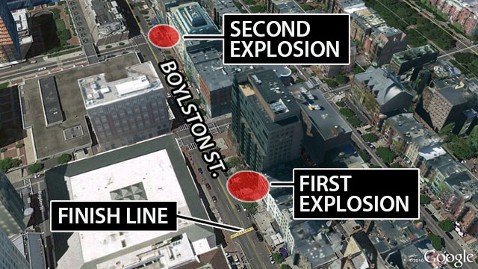
3:28PM: The explosions took place across Boylston Street from Lenox Hotel and Boston Public Library.

4:55PM: Clearly two explosions, one city block apart, on Boylston Street. A third one occurred at JFK Library, a few miles south of Boston, off I-93 [6:05PM: now it is unsure if this is related to the explosions]. There is a 4th bomb discovered somewhere on Huntington Ave (where Boston Symphony Orchestra is located). It is still very confusing especially if Boston is now shut down. If so, then this is similar to 9-11. It is a holiday here today, the Patriot's Day. Many went downtown to cheer on the marathon runners.

5:35PM: We maybe under attack, There maybe bombs along the marathon route. We are asked to stay home/indoors. Boston police urge people to stay out of the city.

5:48PM: Suspect in custody near Boston Common. Good. Let's all see who is behind this monster.

6:07PM: No suspect is in custody. Information changes by the minute, probably should wait a bit longer to see exactly what is going on. Various speeches by politicians, adding no new info.

8:27PM: 3 dead, one an 8-year-old boy. At least 134 hurt. This is a cowardly attack on Boston.
[Scene of the first explosion site - directly across Boylston Street from Boston Public Library]

8:45PM: Governor's press conference: nothing new added, no suspect(s) yet. Hotline for families of victims: 1-(617)-635-4500, and for witnesses who may have information, please call 1-(800)-494-TIPS.

11:25PM: Local media reporting significant police and feds presence at an apartment building on Ocean Ave in Revere, a town north of Boston, populated by new immigrants.

Overnight, now 7AM, 4/16/2013: Copley Square area in Boston downtown is still closed, now a crime scene. Heart-breaking stories of the victims begin to emerge, disruption of normal innocent family lives by pure evil that will forever tarnish Boston Marathon.

4/17/2013: More details on the pressure cooker bombs, designed to maim and kill. The hunt for the bomber(s) is on and is no doubt conducted in high earnest. Bostonians have never retreated in the face of adversity, certainly are not at all intimidated by this cowardly act.

Of the three who perished: The 8-year old victim is Martin Richard of Dorchester. The 2nd is Krystle Marie Campbell of Medford who had worked at Jimmy's Steer House on Mass Ave in Arlington. And the 3rd, a Chinese graduate student at Boston Univ (the family has requested that the name be withheld, even though it has already been widely reported in the Chinese press - update: BU finally disclosed her name, Lu Lingzi; she was from Shenyang).

1:42PM: Cable Channel 13 [Fox 25] reports a suspect has been identified through the surveillance camera records at Lord & Taylor, and the arrest is imminent.

7:04PM: A whole afternoon of confusion. No one was in fact arrested although two men carrying bags matching the description of the bombs were identified from photographic records. Their faces are clearly recognizable, the identities are still unknown, however.

4/19/2013 3:30AM: Disturbance at MIT, off Vassar St, one campus policeman shot and killed. Then gunfire and detonation heard on Mt Auburn St in Watertown. Huge police presence there. Boston Globe now reports one Boston marathon bomber in custody, the 2nd still at large. Apparently one event has led to another in the past few hours. The situation is still "fluid" as the reporters put it.

5:05AM: After much confusion, it now seems that after the MIT shootout, the 2 bombers hijacked a car and let the driver off at a gas station off Memorial Drive. This explains why Watertown which is at the end of Memorial Dr. One suspect was then shot by the police and died in custody. The hunt for the 2nd suspect is now going on.

7:06AM: The 2 bombers are brothers from Chechnya having lived in the US for at least one year.

8:50PM: After one full day of manhunt, it is now over. The 2nd bomber is wounded and captured. A greatest relief to all Bostonians.