2013年5月12日 星期日

History of Tamsui Seaplane Port


For decades since 1945, no one in Tamsui knew why this small town was twice targeted by the US Navy. Thanks to Mr N Hirokawa who has finally detailed the history of Tamsui Seaplane Port, and with it, the background of the attacks. His original post, written in Japanese, can be seen here: http://www.shipboard.info/blog2/ [published on 5/8/2013]. The following is an edited version:

The aerial photo above was taken on Oct 12, 1945, by one of the 13 F6Fs of the 18th US Navy Corps. They were based on carrier "USS Intrepid (CV-11)" then operating off the southern coasts of Taiwan. Three seaplanes on the ground near the sloping runway can be clearly seen. Another appears on the surface of the water to the left with one more locating in the bunker on the right. It is not possible to distinguish if they were mono- or bi-planes from the photo; although, based on records, they were most likely the reconnaissance monoplanes. The railroads of the Tamsui Line and the two cylindrical-shaped oil storage tanks of the Rising Sun Petroleum Co also are seen.

In 1937, The Aviation Administration of the Colonial Governor General's Office began planning for the construction of a seaplane port at 鼻仔頭, near Tamsui Station. It was built in 1941. The twice-monthly flying-boat ran between Bangkok and mainland Japan, operated by the Great Japan Airlines, had used it as the port of call for refueling. Unfortunately, this civilian airline operation ceased on Dec 12, 1941, when the Pacific War broke out.

Subsequently, Model Zero reconnaissance seaplanes were dispatched from 東港Donggang Air Base in Kaohsiung-shu, and deployed in Tamsui for weather observation and security patrols. The Zero's made water-landing, grazing the sandbar, then in the middle of Tamsui River, in a maneuver known to the town folks as "wearing wooden clogs下駄履き".

The operation of the IJN in the vast Pacific Ocean was often hampered by the paucity of well-maintained air fields. The observation and guidance of the accuracy of shells fired by warships were performed by the Yokohama Air Corps using flying boats and the Donggang Air Corps with seaplanes and reconnaissance aircraft. The Mitsubishi carrier-based Zero's had also been re-deployed in many land air bases. And in addition, when outfitted with pontoons, these Zero's also could fly out of seaplane ports.

The IJN air corps were named after the locations where they were stationed. Initially, there was the Tainan Air Corps with re-deployed carrier Zero's and then the Donggang Air Corps, adding a flying boat unit. As the war progressed with re-assignments to the front lines, for counterintelligence purposes, the corps names were changed. And the Donggang Air Corps was re-designated as the 851st Air Corps.

In March, 1945, crack combat units began to move into Tamsui. The 634th IJN Air Corps that had fought in the Philippines moved into Tamsui with its 24 reconnaissance seaplanes (18 on active duty with 6 in reserve), and 250 troops including the commander, aviators, crew, and ground personnel. Barracks in Shilin had been set-up as well. This Air Corps had carried out bombing missions, scoring direct hits on enemy warships sailing from the Okinawa area. Single-wing reconnaissance seaplanes such as Type "瑞雲auspicious clouds" could actually dive-bomb with the two 60-kg or 250-kg bombs on board.

We the Tamsui-lang now understand the first US attack on Tamsui on October 12, 1944, was a pre-emptive island-wide all-out offensive against the military forces in Taiwan. The main target for the attack on May 31, 1945, was Taipei when Tamsui was also hit, probably as a retaliation for the losses incurred by the 634th Air Corps.

Civilian lives and properties of Tamsui/Taiwan lost to the aerial attacks can never be justified, however.
________________________
Additional sources: http://taiwanairpower.org/blog posts on May 19 and September 15, 2012.


2013年5月3日 星期五

After 193 years

The Koxinga Temple in Penang, Malaysia, finally finds its roots in Taiwan.

To formalize the link-up, a statue of Koxinga, known as 金身, is prepared at the Cheng Family Temple in Tainan in an elaborate ritual, complete with food offering accompanied by traditional music. The process, 分靈 or "spiritual cloning" for lack of a better terminology, is required to authenticate the origin of this statue.


The statue is then officially handed over to Chairman Lim of the Koxiga Temple in Peneng for the journey to Malaysia:

Before boarding
Arriving in Penang
Reception at Koxinga Temple in Penang
Finally, the new statue takes up the rightful place (above), replacing the one lost in 1910-20.

After 193 years of isolation, the followers of Koxinga have finally come back to the seat of Tung-Ning Kingdom and celebrated, together with delegates from China and Japan, Koxiga's opening of Taiwan in 1661.

2013年4月18日 星期四

The gate to Taiwan

鹿耳門鎮門宮
[Left: The shoeless Dutchmen door guards of 鹿耳門鎮門宮 (address: 台南市媽祖宮一街345巷420號).]

鹿耳門 (Luermen or Lakjemuyse) was where Koxinga's fleet sailed through at high tide in 1661 into the then Tai Bay, bypassing the defense of Ft Zeelandia, and landed north of Ft Provincia. The Dutch did not anticipate such a move. Ft Provincia quickly fell and Ft Zeelandia under siege for almost one year before capitulating. [For more, see here.]

A tiny shrine located in An-Ping honoring Koxinga and his mother was built in 1990 to commemorate the feat [better late than never]. It was aptly named 鎮門宮Gate-anchoring Palace, for 鹿耳門 was indeed the gate to Taiwan.

The temple fell into disrepair and was re-built in 2006. There are three sets of double-door gates and one of them features a pair of shoe-less Dutchmen. Bare feet跣足 symbolizes the POW status. They were therefore the defeated Dutchmen now guarding doors to the shrine. Their facial depiction is of modern origin, in fact painted by Mr 林中信Lin Chung-Shin. In 2003, the City Gov't of Tainan officially named them 鹿風Lu-Feng and 耳順Er-Shun, and conferred both of them citizenship, complete with shoe offerings. A popular petition to re-paint them with shoes on (so they can travel long distance - back home to the Netherlands) was not approved by the deities, however.

Traditionally, these paired door guards are high ranking generals known for their martial mights. Among them, the very original and the most famous are 秦瓊 (?-638AD) and 尉遲恭 (585-658AD), both Tang generals. Legend has it that the second Tang emperor 唐太宗 [李世民 599-649AD] was disturbed at night by the spirits of those he had murdered. The emperor ordered these two trusted generals to guard the palace gates that indeed effectively warded off the ghosts. Their full-length fully armored and armed portraits were then painted on the doors and found to be equally effective.

With no exception, all Buddhist and Taoist temples of Chinese origin are built with three double-door gates and each gate is guarded by a pair of door gods. The selection of these deities now varies according to the history of each temple.

The photos below show before, during, and after the re-construction of the 鹿耳門鎮門宮:


[We thank Ronnie for calling our attention to the Dutchmen door guards in Tainan.]

2013年4月16日 星期二

A cowardly attack on Boston


Eyedoc reporting from Boston:

It is Boston Marathon Day today. Since the E Africans always win, there is no point of following the progress on TV [addendum: and they did]. We still watch it, albeit only half-heartedly, hoping for surprises. Then all of a sudden, there are reports of two explosions near the finish line at around 3:10PM. Apparently, there have also been casualties.

It is still unclear as to what had really happened, certainly not who was responsible if this had been a terrorist attack.

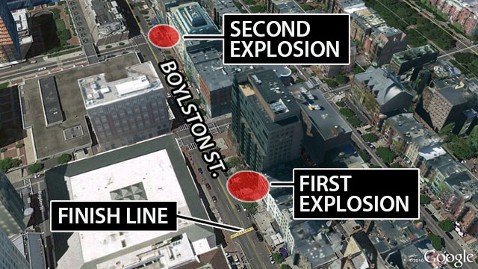
3:28PM: The explosions took place across Boylston Street from Lenox Hotel and Boston Public Library.

4:55PM: Clearly two explosions, one city block apart, on Boylston Street. A third one occurred at JFK Library, a few miles south of Boston, off I-93 [6:05PM: now it is unsure if this is related to the explosions]. There is a 4th bomb discovered somewhere on Huntington Ave (where Boston Symphony Orchestra is located). It is still very confusing especially if Boston is now shut down. If so, then this is similar to 9-11. It is a holiday here today, the Patriot's Day. Many went downtown to cheer on the marathon runners.

5:35PM: We maybe under attack, There maybe bombs along the marathon route. We are asked to stay home/indoors. Boston police urge people to stay out of the city.

5:48PM: Suspect in custody near Boston Common. Good. Let's all see who is behind this monster.

6:07PM: No suspect is in custody. Information changes by the minute, probably should wait a bit longer to see exactly what is going on. Various speeches by politicians, adding no new info.

8:27PM: 3 dead, one an 8-year-old boy. At least 134 hurt. This is a cowardly attack on Boston.
[Scene of the first explosion site - directly across Boylston Street from Boston Public Library]

8:45PM: Governor's press conference: nothing new added, no suspect(s) yet. Hotline for families of victims: 1-(617)-635-4500, and for witnesses who may have information, please call 1-(800)-494-TIPS.

11:25PM: Local media reporting significant police and feds presence at an apartment building on Ocean Ave in Revere, a town north of Boston, populated by new immigrants.

Overnight, now 7AM, 4/16/2013: Copley Square area in Boston downtown is still closed, now a crime scene. Heart-breaking stories of the victims begin to emerge, disruption of normal innocent family lives by pure evil that will forever tarnish Boston Marathon.

4/17/2013: More details on the pressure cooker bombs, designed to maim and kill. The hunt for the bomber(s) is on and is no doubt conducted in high earnest. Bostonians have never retreated in the face of adversity, certainly are not at all intimidated by this cowardly act.

Of the three who perished: The 8-year old victim is Martin Richard of Dorchester. The 2nd is Krystle Marie Campbell of Medford who had worked at Jimmy's Steer House on Mass Ave in Arlington. And the 3rd, a Chinese graduate student at Boston Univ (the family has requested that the name be withheld, even though it has already been widely reported in the Chinese press - update: BU finally disclosed her name, Lu Lingzi; she was from Shenyang).

1:42PM: Cable Channel 13 [Fox 25] reports a suspect has been identified through the surveillance camera records at Lord & Taylor, and the arrest is imminent.

7:04PM: A whole afternoon of confusion. No one was in fact arrested although two men carrying bags matching the description of the bombs were identified from photographic records. Their faces are clearly recognizable, the identities are still unknown, however.

4/19/2013 3:30AM: Disturbance at MIT, off Vassar St, one campus policeman shot and killed. Then gunfire and detonation heard on Mt Auburn St in Watertown. Huge police presence there. Boston Globe now reports one Boston marathon bomber in custody, the 2nd still at large. Apparently one event has led to another in the past few hours. The situation is still "fluid" as the reporters put it.

5:05AM: After much confusion, it now seems that after the MIT shootout, the 2 bombers hijacked a car and let the driver off at a gas station off Memorial Drive. This explains why Watertown which is at the end of Memorial Dr. One suspect was then shot by the police and died in custody. The hunt for the 2nd suspect is now going on.

7:06AM: The 2 bombers are brothers from Chechnya having lived in the US for at least one year.

8:50PM: After one full day of manhunt, it is now over. The 2nd bomber is wounded and captured. A greatest relief to all Bostonians. 

2013年3月20日 星期三

The Douglas Co in Tamsui

At 10:30AM on March 21, 2013, Tamsui re-opens the buildings that once belonged to the Douglas Shipping Co得忌利士洋行 (founded by a Scot, Douglas Lapraik, in Hongkong in 1863).
 
In its heyday when Tamsui reigned as the most important seaport in Taiwan, the Douglas, beginning in 1871, had operated passenger liners sailing to Hongkong and other ports in both Taiwan and China. The company owned administrative offices, dormitories, storage houses and staples, and a large waterfront warehouse in the 龍目井"Wells of the Dragons' Eyes" district in Tamsui. After Japan took over Taiwan in 1895, the Douglas shipping rights were gradually stripped, often by decree, and eventually given to Japanese shipping companies instead. The Douglas company properties, initially leased from the Qing Gov't, were also nationalized by the Japanese Colonial Gov't. And in 1912, a developer 中野金太郎Nakano Kintaro with permission from the gov't had built residential houses for elementary school teachers emigrated from Japan. Some of these houses have survived to this day. 

A few of the Douglas buildings located on No 316 Chung Cheng Road Sec 1 [above], were occupied by squatters when the Japanese left in 1946, while others remained unoccupied, unkept hence becoming quite dilapidated, and were in danger of being condemned. A restoration project was set in motion when Tamsui was administratively still a township with its own budgets.

The Douglas waterfront warehouse was a noted landmark until destroyed by fire in 1959-60. This rare 1945 photo shows a torpedo boat yard to the left of the building. The jumbo seaplane 神津 (J-BACT) parked in front of the warehouse was operated by the Greater Japan Air, it arrived on Sept 9, 1945, from Yokohama, loaded with a large amount of paper money to fund the evacuation of the Japanese. Some would argue that this infusion of money had helped fuel the post-war inflation, seeding the discontent of the Taiwanese with the KMT rule that had led up to the 228 Incident of 1947.

After 103 years, the Douglas buildings are now restored, a
nother piece of Tamsui history coming to life! 

Friends of Tamsui are invited to join us in the celebration of this event. 

Pictorial update (courtesy of TengFeng Fishball Museum):


2013年3月8日 星期五

School myopia in 80 years

This graduation photo of the Class of 1933, Tamsui Elementary School [courtesy of Mr N Hirokawa], shows that none of the students wore glasses. Vision screening with a visual acuity chart was already a standard, in fact, mandatory practice, at that time. It was tested in classrooms by class teachers. More recently, it is carried out by school nurses assisted by teachers.


The DOH reports that by 2006, 61.8% of the 6th Graders are myopic (near-sighted), and in seniors at high schools, 85.1%. This alarming trend continues even today.

While the intense schooling with increasing urbanization in Taiwan may be fundamentally responsible; however, the myopization factors still remain unknown. A large-scale study conducted by EyeDoc and his colleagues may have begun to provide some answers.  

Below is an official announcement on the impending publication (photo of sunset in Tamsui coutesy of Christina Hong) by EyeDoc's group: 


 Risk Factors for Myopia in Taiwanese Children 
Under 12

By age 11 almost 50% of children in Taiwan are myopic
(at least -1D).  Our authors studied almost 2,000
elementary school children (ages 6 to 11 in grades 1 to
6) and found that, of the 20 myopization factors they
looked at, two thirds (66%) of refractive error were
associated with just 4 of those myopization factors.
Those associated with decrease in myopic refractive
error were daily outdoor spectacle wear, spectacles for
different working distances, and weekend outdoor
physical activities.
   Cheng, Huang, Su, Peng, Sun, and Cheng, Am J Optom, April, 2013