2013年1月22日 星期二

A century of medicine in Taiwan


This (above) is a ca 100-year-old photo showing a Japanese 漢醫[Han physician] diagnosing a patient. The elderly physician, apparently making a house-call, was using a method known as 把脈 [pulse/blood vessel-reading], through which the origin of the illnesses was determined and the therapy with traditional Chinese medicine started. In rural areas of Japan, this was apparently the norm, not any different from the more authentic 漢醫s then also practicing in Taiwan. [Note: The sword in the foreground was a Doctor's Sword, a Bokuto 木刀 (wooden blade), not a Samurai sword.]

On May 29, 1895, Japan invaded Taiwan. And 3 weeks later on June 20, the first military field hospital 台灣病院Taiwan Hospital, was established in a large residential house in DaDaoChen, Taipei, staffed by 10 physicians, 9 pharmacists, and 20 nurses - all of them from Japan trained in western medicine. Limited medical training classes for the locals had also started in this hospital, marking the beginning of structured formal medical education in Taiwan. [Note: Prior to this, the Presbyterian missionaries had also trained local assistants although only through apprenticeship.]

In 1896, several hospitals, including one in Tamsui, were also built to treat patients with 鼠疫 (plague, black death). This disease, however, was not indigenous to Taiwan, most likely imported by the Japanese invading forces. Cases of cholera was also found on board of Japanese war ships. These and the cholera epidemics in latter days were transmitted into Taiwan by outside visitors. A major illness native to Taiwan (and all tropics) was the mosquito-born but-not-always-fatal malaria. To prevent these diseases from spreading, improving sanitary conditions was of course a must. In later years, the improvement would prove highly beneficial.

Hygiene issues alone, however, did not do the Japanese soldiers in when they first arrived in Taiwan, however.

[The present 台大醫院NTU Hospital, newly constructed in 1919, that replaced the original 台灣病院, photo from http://pylin.kaishao.idv.tw/?p=853http://pylin.kaishao.idv.tw/?p=853]

The colonial gov't had claimed that in the 1895 invasion, the Japanese had suffered a loss of 164 to combats and far more, 4,642 in all, had succumbed to diseases. Whether the casualty numbers were truthful and if a deliberate mis-classification of the war-dead to imply prowess of the fighting men both issues aside, the 4,000+ deaths were actually blamed on the "unsanitary" conditions in Taiwan. This is hogwash: (1) living conditions in Japan were similar to or even worse than in Taiwan (see photos below), neither was under constant assaults by infectious diseases, and Taiwan also did not report any significant epidemics at that time, and (2) most of the death from illnesses were owing to the raging beriberi, from the lack of vitamin B1 in the Japanese soldier's ration of polished white rice (cf a previous post, here). Plus, as stated above, these soldiers were also carriers of several deadly infectious diseases. In other words, the Japanese had brought death with them, not in a scenario in which the diseases were lying in wait and ambushed the hapless soldiers as soon as they had landed in Taiwan. Epidemics do not spontaneously occur until the infectious agents are accidentally introduced into a vulnerable environment, much like that in Europe during the plague epidemic in mid-14th century. The same applied to Taiwan in 1895.

A quick comparison on the standard of living between Japan and Taiwan is in order. It should be noted that neither was in the grip of an epidemic:

[Century-old photos. Above: a small town/village near Nara in Japan with houses with straw roofs, a ditch, and unpaved roads, and below: farmers with children, in front of a shinto shrine]

And in Tamsui/Taiwan, as an example:

[Above: the 新店Hsin-dian section of Tamsui of unknown date during the Japanese rule (from http://taipics.com/taipei_danshui.php), notice the sewer, paved srteet and the telephone poles, and below: well-dressed kids in leather shoes, photo taken in front of 龍山寺Lung-Shan Temple in Tamsui in the 1920s]
The pictorial face-off above, in favor of Tamsui, may be a bit unfair in the temporal sense, albeit only slightly. In fact, in under-developed frontier territories in Japan, the living standards were far poorer than in western Taiwan. The additional difference was that the Japanese Colonial Gov't did vastly improve not only the infrastructure but had also instituted education and public health systems to make Taiwan a better place to live. While in contrast, the central gov't of Japan did not apply the same efforts to some parts of, for example, Kyushu and Hokkaido. In those early colonial days, Japanese in mainland Japan often referred to Taiwan as "鬼界の島[an island bordering the underworld]" or as the "land of poisonous snakes and malaria", they had been seriously mis-informed.

On May 1, 1899, a formal medical school 台灣總督府醫學校 began accepting students and it eventually evolved, in March, 1928, into the Affiliated Dept of Medicine of Imperial Taihoku University, i.e., the 台北帝國大學附屬醫學專門部. In April, 1936, a new university-level School of Medicine 台北帝國大學醫學部 was also formed to conform to the organization of the Imperial University system - this was the predecessor to the NTU School of Medicine today. These two schools ran in parallel until 1945 when the colonial rule ended. For some years, there were three alumni associations, finally merged in 1979 into 景福會 of today.

Improving medical education is often cited as one of the major Japanese contributions to the modernization of Taiwan. This is certainly true.

In 1895, the 漢醫s in Japan lost grounds to western medicine and receded into obscurity, only to re-surface in the 1970s owing to a renewed interest. In 1900, the Taiwan medical licensing law was enacted, and the Taiwanese 漢醫s were forced to re-train or simply went underground and risked prosecution for practicing medicine without a license. The official return of Taiwanese 漢醫s started in 1958 with the establishment of China Medical University, originally the 中國醫藥學院, in Taichung.

With Taiwan reverted to ROC rule in 1945, medical licensing became an issue principally because the Ministry of Interior in Nanjing was unfamiliar with the medical education of the Taiwanese. Indeed, the level of training did vary among the applicants trained in an era of progressing medical education inside the Japan Empire. Some were graduates of university-level medical schools, many more graduated from independent private medical colleges. The schools were located not only in Taiwan but also in Japan and former Japanese territories including Manchuria, Korea, and Southern China. Also, during the Pacific War, there were highly educated and much experienced battlefield medics, physician's associates, and immunological assistants. Most were eventually granted either a full or a limited license similar to those certified under the Japanese system. [Note: Adding to the confusion, after 1949, KMT soldiers trained to provide first-aids also petitioned for and received issuance of restricted licenses.]

Medical education in the Japanese/German mode continues to this day. Attempts to switch to the American mode have met with minimal success. Today, despite the shortcomings of the National Health Insurance, people in Taiwan enjoy high-quality healthcare unavailable in many other nations in the world.

2013年1月16日 星期三

Another Formosa

Little known factoid: The Province of Formosa in Argentina (black dot on the map is the capital city, also named Formosa) is partially antipodal to Taiwan. That is, they are situated at the opposite side of the earth. Pure coincidence.

The City of Formosa in Argentina was founded in 1879 by Commander LJ Fontana. The territory became a province in 1955 through the decree of Juan Perón. It has twice the area of Taiwan with only half a million residents. The name Formosa originated from archaic Spanish fermosa (now hermosa), not from Portuguese as that for Taiwan.  Both mean "beautiful", of course. 

Also purely coincidental, as in Taiwan in 1947, a massacre had taken place. This occurred in the Rincón Bomba area, where the gendarmes (policemen) using machine guns murdered hundreds of aborigines (the Pilagá people) for refusing to work under deplorable conditions in the sugar plantations. The official version alleged that the aborigines attacked the police first - a total fabrication.

The police intimidation went on in this border state for the next six decades and the tragedy remained hidden until 2005 when the first mass graves were discovered. Things have not improved much since, though; the Pilagá people still live in abject poverty. The dominance of the ruling class from the Spanish colonial system established 500+ years ago seems still alive and well today.

In contrast, the Spaniards had never really had a firm grip of Taiwan and were forced out from the island by the Dutch in 1642. The Spaniards and the Dutch were also quite often attacked by the aborigines in Taiwan.

Surprisingly, there is no diplomatic, commercial, or any other relationship between the two Formosa's. There may be a kind of a "link", unknowingly and tenuously forged for sure, through the bird Toco Toucan (below), native also to Formosa, Argentina (among other S American regions). Toucan is known in Formosa/Taiwan as 大嘴鳥, originally a main character in the Japanese キョロちゃん or the Morinaga ChocoBall cartoon series. Most kids know the theme song by heart.

2013年1月10日 星期四

VOC in Tamsui

[Above: Trade routes of the VOC]

It is well-known that the Dutch East India Company (VOC) settled in Tainan area after its attempt to dislodge the Portuguese from Macau had failed. And its turf war with the Spaniards raged on, even in Taiwan. The Dutch eventually took over both Keelung and Tamsui from the Spaniards in 1642, and went on to build, in Tamsui, Ft Anthonio (the now Red Fort, Ft San Domingo), set up residences, intermarry with, and also fight against the Aborigines. And to support the garrison force in Keelung, instead of shipping supplies in from Tainan, the VOC had acquired farmland north of Tamsui, irrigated by a small stream with clean water, and contracted out the land to the locals to grow food. This river, known as the [Dutch East India] Company Field Creek (公司田溪), still flows today. It empties into the sea in Shalun沙崙 area [on the upper left corner of the hand-drawn map below (click to enlarge)].

[Map of Tamsui by an unknown maker, apparently a Tamsui-lang]

This sparsely populated area is in fact quite rich in history. In addition to the presence of the Dutch East India Co, it was also where the Battle of Fisherman's Wharf during the Sino-French War was fought. And both Chinese and French war dead, the latter including Lt Fontaine, were also buried here.

History, however, will soon intermingle with the new. Not only Shalun, further north, the New Tamhai City 淡海新市鎮 has long been under development, and is still a work in progress, slowed by the lack of a good public transportation system.

In 5 years, however, there will be the Tamsui Trolleys running the Green Mountain Line (7.34 km) and the Blue Sea Line (7.86km) as an extension of the Taipei Metro:
 
淡水捷運輕軌延伸規劃路線有二:

 一是綠山線,由捷運紅樹林站沿中正東路、淡金公路往北,至濱海路往西,於沙崙路轉往北至新市六路路口,路線長約7.34公里。

第二是藍海線,起於中山路與中正路之分隔島,中山路與中正路各布設平面單軌,至新生街與中山路交會後併為雙軌,並沿臺2乙線往西至沙崙海水浴場淡海路右轉,經11號計畫道路跨公司田溪後再右轉,沿濱海路至沙崙路口後,往北與綠山線共軌,路線長約7.86公里,其中與綠山線共軌部分約為1.21公里。

And in graphic form:

The Green Line will eventually extend north into 淡海新市鎮 (in the general vicinity of the St John University in the diagram above, northwest of "downtown" Tamsui) designed to accommodate 300,000 and yet only 11,000 or so souls have moved in so far. With the trolley lines completed, this somewhat delayed yet still a newly minted city will see a real estate boom. And with it or long before, we hope an increasing effort in the preservation of historical sites.


2013年1月4日 星期五

Taiwanese identity

Below is an interesting article, published on 12/30/2012, written by Han Fook Kwang, past editor-in-chief of The Straits Times in Singapore. In it, Mr Han mentions the "Taiwanese identity" as being the basis of the civil-mindedness of the citizens of Taipei/Taiwan. The experience is apparently quite intense, Mr Han has to remind himself a few times that he is visiting Taipei, not Tokyo. 

Indeed, besides the examples cited by Mr Han, only in Taipei/Taiwan where people automatically step to the right side of the escalator to allow others through on the left side, not seen elsewhere in cities such as Tokyo, Boston, New York, and San Francisco. And only in Taiwan where you see kids say thank-you to the bus driver before exiting the public bus. 

Taiwanese identity, however, has always been there, it was simply forced underground in 1945-46 when Taiwan already had begun to modernize - only to re-emerge, but merely in part, in the late 1980s. It is still an undercurrent yet its presence is felt all the time, even by Mr Han, a visitor from outside of Taiwan. 
I couldn't find any public dustbins in Taipei where I was visiting about a week ago.

The city was clean and as well kept as any I have seen elsewhere.

But nobody throws rubbish here? What happens if you've a piece of tissue paper you want to get rid of?

Leave it in the pocket?

That's what the Taiwanese do, said my guide. They dispose of it when they get home so they can separate what can be recycled from the rest.

That's really impressive, I thought, especially considering how difficult it is to get Singaporeans to recycle their waste, let alone carry it home with them.

I had to remind myself I was in Taipei, not Tokyo where you expect the Japanese to be ultra civic-minded.

It was one of several surprises about Taipei and its people, which overturned my previous preconceptions about the place.

Truth is I didn't know very much about Taiwan, not having visited for more than 20 years - I was last there on a brief news assignment.

Much of what I knew came from reading the papers and watching the news on television, and it was mostly negative - the unruly politics, fist fights in Parliament, and headline-grabbing melodramatic elections (remember the mysterious shooting of then President Chen Shui-bian a day before the 2004 presidential election?).

There were other revelations from my visit.

At Taipei's MRT stations, commuters waited in orderly, single-line queues for trains, a sight you don't see here in Singapore, and their trains are just as crowded.

(Second reminder - it's not Tokyo.)

But the stand-out observation of my four-day visit was the service at restaurants.

It was better than Tokyo's.

These were not fine-dining places that I visited, where you expect service to be good, but popular ones such as Din Tai Fung and T.G.I. Friday's, both of which are also in Singapore.

I have never experienced such personal, enthusiastic and know-ledgeable service anywhere in the world - and from very young waiters barely out of school.

It was packed in Din Tai Fung, so you couldn't say the exceptional service was because it was a slow day there.

The issue of how to get Singaporeans to be more civic-minded has been an evergreen one because there are too many examples of bad behaviour which have gone uncorrected for too long.

Commuters blocking the way of those getting off the trains, diners not returning their trays at hawker centres and foodcourts, residents not recycling their waste, moviegoers using their mobile phones in cinemas. Many visitors have also commented that the city isn't as clean as it used to be and more people have been caught littering in public places.

The list goes on.

That's not even including how motorists behave on the road - top of my hate list being the way they accelerate instead of giving way the moment they see another driver signalling to get into their lane.

It's often said we're a First World economy but without the accompanying social graces, and that it'll take another generation before we get there.

It was such a refreshing change to visit a city where you could see a qualitative difference in social behaviour and attitude towards one another, and which was not so culturally or economically different from Singapore that it seems like an alien place.

It's how I feel about Japan - it sets a very high standard for courteous behaviour and public-spiritedness but Japanese society is hard to fathom and the social codes are so opaque to outsiders it seems like a world apart.

Singaporeans will never be like them, so there's no point studying how they do it.

But Taiwan is predominantly Chinese, and much more similar to Singapore.

It disproves the point that some people here have made that one reason for the mediocre service in retail shops and restaurants is that Chinese people are not known to be service-oriented, unlike say Thais or Filipinos.

Taiwan proves this wrong.

But if it was just about service, it wouldn't be such a big issue.

A Gallup survey put Singaporeans right at the bottom of 148 countries for lacking emotion and for being the least positive.

You could argue with the flawed way the survey was done, as many critics have done, but it still sucks to be bottom of the class.

More disconcerting was the finding of the World Giving Index two weeks ago that Singaporeans were one of the least likely people in the world (140th out of 146) to have helped a stranger in the past month.

As for giving money to charity, the score wasn't great either - 53rd, and way behind other South-east Asian countries such as Indonesia and Thailand.

I couldn't think of a worse dampener to the year-end celebrations.

Many reasons have been given for Singapore being so far behind in these softer aspects of our development.

Among several: Because we're a fast-paced, competitive economy in a densely populated urban city, people here have less time to be nice to one another. And that we're a society in which just a generation ago, many among our parents came from some of the poorest villages in China and India and who might not have grown out of their peasant habits.

But Hong Kong is just as compactly populated with immigrants from a similar background, yet it ranked 19th in the overall index, 95 places ahead of Singapore.

America is one of the most competitive economies in the world and was rated fifth.

I believe there is a common thread running through societies that do so much better than others in this area.

It has to do with having a strong sense of community and identity among the people, that they are in it together and so have to look out for one another.

It's like being part of a family, no one needs to be told to do his or her part for the other - it should come naturally because the ties that bind are as strong as Mother Earth.

When I asked a colleague who has worked in Taipei what accounts for the behaviour I observed there, she said there were many reasons, one of which was that things became noticeably better as a result of the civic movement during the years leading to the lifting of martial law in 1987.

Those were the years of political and social awakening in Taiwan when the people became more involved and participated more actively in the issues that mattered to Taiwan.

As a result, they developed a stronger sense of Taiwanese identity.

Their politics is often ugly and the economy has been sluggish for some time, but they appear to have made greater strides on the social front.

For Singapore, the challenge is greater than in a homogeneous society like Taiwan.

It is why all those top-down campaigns to get people to return food trays, stop littering, or move to the back of buses will have only limited success because Singaporeans don't feel strongly enough that they are one community and will look after one another.

That's the painful truth and acknowledging it is necessary before progress can be made.

Forging those bonds requires action, not words, from as many people as possible doing things for the common good, and not for themselves and their families. That means a much more vibrant civic society, one where Singaporeans truly believe they have an active part to play in shaping the future of this place.

The more civic organisations, interest groups, non-governmental organisations, charities and volunteers there are doing their bit in whatever area they are interested in, the greater will be this sense of community and ownership.

Conversely, if it's all done by the Government, the weaker the bonds.

But it also requires the Government to respect and support the work done by these groups.

There's clearly much more at stake than just uncleared food trays.


2012年12月30日 星期日

Happy New Year

And a Prosperous 2013 to All! 
Sunset in Tamsui, courtesy of Christina. It is a toasty* 7.5C in Tamsui today. Please come and visit. 
*Relatively speaking of course, here is Boston, 30F now, by Thursday morning, 15F.


2012年12月6日 星期四

Hoklo in Western literature - 1843

The above is excerpted from The Baptist Missionary Magazine, vol 23, p 278, 1843, part of the journal of Rev Roberts who was then preaching in Hongkong

"16. Took my teacher, Wong, and went on a family visiting tour. The first family visited spoke the Hoklo dialect. The assistant not being with us, we could but partially understand each other..."

And in the next paragraph: "At a later hour, in company with the assistant, Mr. Young, and Wong, my teacher, visited Titam village, and a family there, who speak the Hoklo dialect; which is nearly the same as Tiéchiú, which the assistant speaks."

These appear the first mentions of Hoklo in the Western literature. Tiéchiú = 潮州話, which is indeed another form of Hoklo.

The entire volume can be found in Google Books here: https://play.google.com/books/reader?id=4gHPAAAAMAAJ&printsec=frontcover&output=reader&authuser=0&hl=en&pg=GBS.PP1

Hoklo [河洛話], officially the Min-Nan [閩南語], is the primary language of most Taiwanese. 閩南 refers to Southern Fujian where the ancestors of most Taiwanese migrated from. The term Min-Nan has been used as a reminder of its Chinese origin. Outside of Taiwan, Hoklo is also known as Hokkien [福建話], spoken by 華人 (residents of Chinese origin) predominantly in the Philippines and SE Asia that includes Singapore, Malaysia, and Indonesia.

A language becomes extinct only because of disuse and replacement, e.g., the Manchurian language, or simply because no one is left to speak it. There is a long list of dead languages, none through banning by decree, however. The latter has been tried in Taiwan, most recently in 1946. Today, Taiwanese speak not only Hoklo but also Taiwanized Mandarin Chinese, or 台灣國語, that borrows liberally from Pekingese and other dialects from China, English, and Japanese.

2012年11月30日 星期五

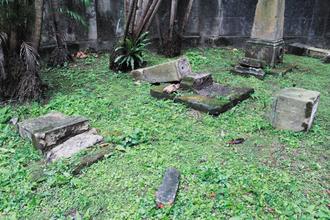
Vandalism in Keelung

[A memorial built in Oct 1909 in honor of the French war-dead during the Sino-French War - inscription in Kanji on the base reads: 西元一千八百八十四年及五年佛清之役,葬佛軍將卒戰死者於此。本年重修建立紀念碑以傳後世。西曆一千九百九年十月立]

  [ici reposent officiers soldats et marins Francais decedes a kelung 1884-1885 - "Here lie French officers, soldiers, and marines who perished in Keelung, 1884-1885"]

We are disturbed to see a recent news report [UDN 2012.11.29 11:20 pm]:

基隆市定古蹟「清法戰爭紀念園區」裡頭的6座墓碑20日遭破壞推倒。警方清查路口監視器及公車行車記錄器畫面,發現有毒品前科的38 歲江姓男子涉嫌重大。Six headstones in the Sino-French War Memorial Garden in Keelung [located at the intersection of Chung Cheng Road and Tung Hai Street基隆市中正區中正路與東海街交叉路口] were pushed over on the 20th. The police, after examining surveillance videos, have found that a 38-year-old Mr Jiang, with prior drug abuse records, the prime suspect.
 
基隆市警二分局申請拘票後,29日下午拘提江男到案。他坦承推倒墓碑,供稱是因為被亡魂託夢,表示埋在裡頭無人祭拜很可憐,才想破壞墓碑,讓一切回歸自然。警方訊後將他依違反文化資產保存法罪嫌,移送基隆地檢署偵辦。
The police arrested Mr Jiang in the afternoon of the 29th. He admitted vandalizing the headstones claiming that the long ignored lonely spirits made him do it and that he was simply trying to return everything to Nature. Mr Jiang was charged with violation of the heritage preservation law and transferred to Keelung DA office for further prosecution.

Another UDN report on 11/23/2012 stated that

基隆市定古蹟清法戰爭紀念園區的墓碑,20日遭人破壞。法國在台協會人員昨前往查看,了解毀損情形。文化局表示,和法方交換意見後,將以「回復原貌」方式修復,不再重新立碑。這兩天會請廠商估價,希望將修復價格控制在10萬元以內,盡快恢復古蹟舊貌。
Representatives of the French Association at Taiwan have visited the vandalized site to survey the damages. The Cultural Bureau plans to restore the headstones to their original state without erecting new ones. A contractor has been contacted. The cost is estimated to be under NT$100,000. And it is expected that the restoration will be completed post-haste.

只有懦夫才會找已往生的人麻煩. Repose en paix, messieurs.

Additional note: the same had happened in 1885 albeit under different circumstances, see a previous post: http://danshuihistory.blogspot.com/2011/05/fraters-report-on-july-1-1885.html

Briefly, British Consul Alexander Frater reported that "Shortly after the evacuation of Kelung by the French, their cemetery was attacked during the night, and the monuments and wooden crosses were thrown down. Happening to see Liu Ming-ch'uan on the 14th instant, I spoke to him about the outrage and said the French would be sure to be very angry if they heard of it. I advised that he should cause repairs to be made. He replied that he had been told of the occurrence, and had given orders for the cutting in stone of a protective proclamation, a copy of which he showed to me. He added that he had already ordered the tombstones to be put up again, and asked whether I had not heard that his orders had been carried out, to which I could only reply that I had not. The repairs were begun only on the 18th, soldiers being employed for the purpose; but the tombstones were thrown down again during the night. I was in Kelung on the 26th and 27th and visited the Cemetery. The proclamation cut in stone was not there, nor was it on the spot on paper. Two or three of the monuments had been fairly handsome ones and it was sad to see the top portions of them lying broken off. Many of the wooden crosses had been removed, and thin bamboo ones put in their place."