2012年10月30日 星期二

Coming home - Part 5

[The main altar with Koxinga in the center. This statue resembles the one in the Cheng Family Temple in Tainan, both clean-shaven. The one in 延平郡王祠, also in Tainan, is based on a portrait with a black beard suggesting it was done during a mourning period. In Hokkien custom, sons do not shave when their parents passed. ]

The full name of Khye-Sian-Ong-Tua-Pek-Kong temple in Jelutong日落洞, Penang檳榔嶼, is 開山王大伯公廟. We already know who 開山王 is [Koxinga], but who is 大伯公 (the bearded one on the right), and why a third deity (the child on the left), apparently NaZa哪吒, is also on the altar?

Stay tuned.


2012年10月24日 星期三

Coming home - Part 4

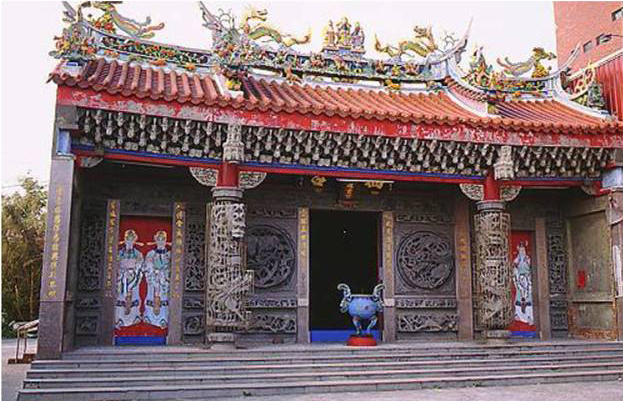
[Above: Fu-Ling Tample in LuKang鹿港福靈宮]

Were there Taiwanese in Penang in the late 1700s? It appears so. Fung-yin provided one fairly prominent example:

"。。。居同安白礁(今属龙海县,早属泉州,清末民初属厦门)。元朝至正年间(公元1341年),十九世孙辜志明由白礁迁泉州打锡巷。志明九世孙辜旺于明崇祯(1628年)由泉州迁惠安洋埔,是为惠安辜氏一世公。旺之六世孙邦变(洋埔三房)于清乾隆初年移居惠安上坂(昔称象坂)东村,蕃衍生息:长子水英、次子尚、三子宗。辜宗于乾隆四十年(公元1775年)趁开海禁携眷赴台谋生,择居鹿港。辜宗四子之一辜礼欢又赴马来西亚槟榔屿拓展,为英属马来西亚首任甲必丹(地方首领)。辜礼欢生八子三女,其子之一辜安平自小送回国内读书。中进士后,为林则徐幕僚,后调任台湾并定居鹿港。安平之孙辜显荣为台湾巨富,被誉为“百年昌盛家族”。辜显荣即是辜振甫之父。安平胞兄弟龙池之孙为辜鸿铭,故辜振甫称辜鸿铭为“鸿铭伯”。上坂辜氏,历经坎坷, 以小手艺谋生,又属小姓,旧时怕受欺凌,曾一度恢复林姓。1952年又复辜姓。"

In short, a Gu family member, 辜宗, migrated to Taiwan in 1775 and settled in LuKang. One of 辜宗's four sons, 辜礼欢 then moved south to Penang to seek and in fact found more fortune. He became the first Kapitan of the British Malaya and raised a large family with 8 sons and 3 daughters. One of them 辜安平 was sent back to China to study who eventually returned to LuKang. And in 1895, one of his grandsons 辜顯榮 (1866-1937) invited the Japanese invading force to enter Taipei to keep peace as Taipei was then being looted by the retreating Qing soldiers. In return, the Japanese rewarded him with various trading rights. Gu became immensely wealthy as a result. And this branch continues on, active in Taiwan banking and commerce to this day. It is, however, unclear as to the fate of the branch in Penang, most likely as wealthy and influential as the Taiwan branch. In stark contrast, those who stayed behind in China did not fare so well.

It should be noted that LuKang was the stronghold of 洪門天地會Hong-Men Heaven and Earth Society rebels led by Lin Shuang-Wen林爽文 (1756-1788). The 福靈宮 (pictured above) honors one of Lin's generals, Wang Shun平海大將軍“王勳”.

The activities of 洪門天地會 in Penang, reported by the British Admin in 1799, now appears a matter of course.

2012年10月17日 星期三

Coming home - Part 3

It is a time-honored tradition that when a temple is built, the names of the donors are literally etched in stone and stone tablets are erected on temple grounds in perpetual memory.  In fact, there are such tablets inside the Khye-Sian-Ong temple in Penang; although, curiously, the first one was dated 1864. The only memorial going back to the year 1820 is again the foundation stone:

A close examination of the inscription in Chinese reveals  something intriguing. Normally, any mention of the names of the Chinese emperors, strict rules known as 避諱 must be followed. In written documents, for example, an emperor's name wherever encountered must begin at the top of the page and the characters must not be in a complete form, usually one stroke less. These are to show the utmost respect to the emperor. Violate these rules, the consequences can be quite dire.

And yet, in this founding stone, the emperor's name was carved in a complete traditional character followed by a simplified character 嘉庆. Notice the 庆, instead of 大, has a 犬 inside the character. This is not a common form, and 犬 means dog, a lowly animal. In other words, this was a deliberate insult aimed at the Qing Emperor 嘉慶. The multiple mention of the year referring to 1820 also suggests a reluctance in accepting the Qing imperial calendar.

Who would have been so brazen as to create this ultimate anti-Qing expression? In that era, the Heaven and Earth secret society readily stood out.

Indeed, it is known that "早在1799年,英属槟榔屿政府就发现天地会活动的记载, i.e., as early as 1799, the British Penang Admin had discovered and recorded the activities of the Heaven and Earth Society". This statement is of immense importance. It provides the crucial extension from the past, since the 洪門天地会 or the Hong-Men branch of the 天地会 Heaven and Earth Society was linked directly to Koxinga.

Koxinga was honored as 萬雲龍 or 萬大哥 [Chief Big Brother Wan] of the society and Chen Yong-Hua [陳永華, 1634-1680 - Koxiga's political consultant and later the Prime Minister under Koxinga's son 鄭經Cheng Jing] further expanded the operation under the pseudonym 陳近南. These aliases were adopted later by the secret society to avoid detection of its anti-Qing restore-Ming activities by the Qing government and the consequential prosecution with severe punishments.

This may explain the reason why the original donors of the Jelutong temple had chosen to remain anonymous.

The Hong-Men itself was first started by Yin Hong-Seng 殷洪盛 during the rule of the last Ming Emperor of China 崇祯 Chung-zhen. After the fall of the Ming Dynasty, the fight of the Han people against the Qing invaders continued. Yin was eventually killed in action, and his son 洪旭Hong-Xu together with the remaining generals then joined Koxinga's force. And the character Hong洪 became a code word used by the members to greet one another.

To this day, branches of this now semi-secret society can still be found in Chinatowns all over the world.

2012年10月13日 星期六

Coming home - Part 2

開山 Kai-Shan or mountain-opening means trail-blazing, not unlike the first Europeans settling in the Midwest and the West Coast in the US, two centuries ago. In the Chinese tradition, ancestors are often memorialized in family temples. Sometimes, a prosperous enough clan may choose to build a large temple to worship the very first ancestor, elevated to the deity status through Taoism. For example, in Penang, Malaysia, the Chen clan worships 開漳聖王 who was the first ancestor to settle in 漳州Zhang-zhou in Hokkien. The sage-kingship was an honorary title in Taoism.

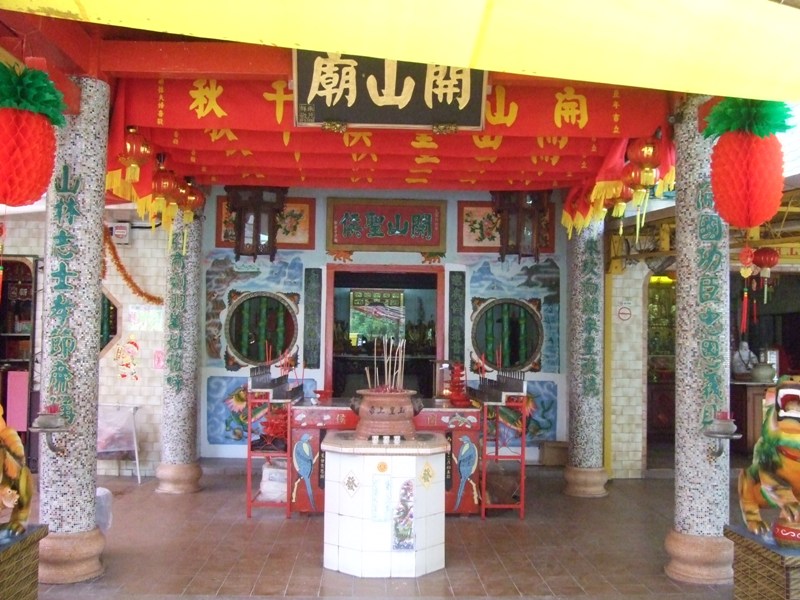
Sometimes, however, the use of  開山 in the temple title deviates from the norm. An example is the Khai-San Temple located in Bukit Merah in Singapore:

This one honors Jie Zi Tui (介子推, ?-636BC), born in the Spring-Autumn Period (春秋時代), in now 山西介休. His story is one of loyalty and piety. He sliced off a piece of his own flesh and prepared it into soup to serve his starving master, then escaping from the enemies. When his master finally became the King of 晉 Nation, Jie Zi Tui resigned quietly from his high post to be with his aging mother, and both of them then resided in 綿山Mian Mountain. The King's summons for Jie Zi Tui to return to his court to be honored went unheeded. In a half-brained attempt to force Jie out from hiding, the mountain was torched, only to find both Jie and his mother died in the fire, huddled together under a tree. Jie was honored posthumously by the king and the populace. The term Khai-San of the temple in Singapore, however, is only a tangential link to the Mian "Mountain". It has nothing to do with any pioneering activities.

Unlike Southeast Asia where Hokkinese en masse had also migrated to, in Taiwan, 開山 has retained its original meaning and 開山王 is still a true, not a Taoist, kingship title in reference to the one and only Koxinga. The only other temple that has 開山 in its name is the 開山宮Kai-Shan Palace in Tainan. It was erected by the Ming-Cheng Kingdom to honor 陳稜Chen Ling.

In 台灣通史 vol 22  (published in 1920), 連橫 wrote that, "開山宮: 在府治內新街。鄭氏時建,祀隋虎賁中郎將陳稜。乾隆五年修。而舊志以為吳真人,且謂臺多漳泉人,以其神醫,建廟獨盛。夫吳真人一醫者爾,何得當此開山之號?鄭氏之時,追溯往哲,以稜有開臺之功,故建此廟。而今又誤為開仙宮,更屬不通。" It is possible that, not realizing who Chen really was, other deities had been invited by the overseers to increase the temple attendance. A physician-deity, Dr Wu, would fit the bill well for those seeking medical miracles.

陳稜 (? - 619AD) was a general of the 隋Sui Dynasty (581-618AD). Records show that he had sailed from 潮州Tiochew to conquer 流求Liu-qiu in 610AD. Some, including the Ming-Cheng officials, argued that Liu-qiu was actually Taiwan while others thought it was Okinawa. This is still in debate even now; although this deed has already been cited by some in China as the historical evidence of Chinese ownership of Taiwan (or Ryukyu, for that matter).

Back to 開山王. Inside the Khye-Sian-Ong-Tua-Pek-Kong temple in Jelutong日落洞 in Penang檳榔嶼, these plaques, dating back to when the temple was built, are found:


Clearly a temple that honors Koxinga, the 開山王, at least in the Taiwanese definition. To our knowledge, this is also the only one in SE Asia. But who had built it, back in 1820?

2012年10月12日 星期五

Coming home - Part 1


Visitors to the Khye-Sian-Ong-Tua-Pek-Kong Temple in Jelutong, Penang, are often intrigued by a memorial stone. The inscription has both English and Chinese parts. The English part reads:

“This ground was given to the Chinese community to erect a temple by Ichik Jemal, The late penghulu of this district on Nov 1820” 

And the Chinese part (above, highlighted with water-soluble dyes), a mention of the year 1820 in multiple calendar forms:

嘉庆二十五年一八二0
庚辰1820年 龍年

In other words, this temple has a long history and in fact has just celebrated the 192nd anniversary of its founding.

Khye-Sian-Ong is the Hokkien pronunciation of 開山王, a title that refers specifically to Koxinga.  And this is also where the story begins.

2012年9月27日 星期四

BK24 火車吃水

Locomotive BK24 of the Tamsui line (1901-54) can now be found on 光復Guang-fu Campus of National Cheng-Gung University in Tainan. It was putatively donated by the Railroad Bureau to the university, or more precisely to its mechanical engineering department, sometime after it was decommissioned. This gifting was done apparently without consulting the Tamsui Township or any of its folks. Part of its innards have been removed allegedly for educational purposes and the cylindrical body now sports two gaping holes. It also has gathered a thick layer of dust. Even so, it retains its original majasticity:

Accompanying the display, a plaque (below) shows the specs of the steam engine and the very last line mentions that it has served the Tamsui RR Line. The writer apparently had no idea what the Tamsui Line had played in the lives of Tamsui-lang. The folklore is replete with love stories at a time when boys and girls commuted one hour each way to attend the best high schools in Taipei and the sparks flew. This is no longer possible with the now always crowded Taipei MRT. 

The Township will now request that BK24 be returned to its rightful place. If everything goes well, it will be installed on the exact same spot where it re-loaded water and coal:
 
The above is a photo taken possibly in the early 1950s showing the water tower and next to it, the guzzling BK24. This was known fondly to Tamsui-lang as 火車吃水.

2012年9月5日 星期三

How to govern Taiwan - Part 3

Chen Yi 陳儀 (1883-1950) was the first post-war governor of Taiwan, appointed by Chiang Kai-Sek on Aug 29, 1945 and arrived in Taiwan with his entourage on Oct 24 to take up the office. On Oct 25, he presided over the surrender of the Japanese. And, as we all know, the 228 Incident of 1947 occurred under his failed governance.

Was he qualified to rule Taiwan? As it turned out, yes, at least on the surface:

(1) He was educated in Japan in 1902 and again in 1919 when he graduated from the Military Academy of Japan and also married a Japanese.
(2) In 1935, he visited Taiwan and was impressed by the rapid progress made under the Japanese rule. After more intelligence gathering, he published a report on Taiwan 台灣考查報告 in 1937.
(3) Also in 1937, he became the Provincial Chairman (Governor) of Fujian (Hokkien) and sought to reproduce the Japanese success of economic development in Taiwan.
(4) In anticipation of the return of Taiwan to China, in 1943, he chaired the Taiwan Survey Committee of the Nationalist Gov't and filed two reports, one an expansion of the previous survey and the other, the 台灣接管計劃綱要Outline of the plans for taking possession of Taiwan.

Similar to Goto Shinpei of the Japanese Colonial era, Chen Yi had also reached a number of conclusions from his exhaustive studies. Surprisingly and unfortunately, they were highly inaccurate and his strategy apparently based on China-centric views:

(1) Just like during the Qing rule, Taiwan was once again regarded as a conquered land. Chen et al had failed to realize that Taiwan was already on its way to becoming a modernized society with its people enjoying a much higher living standard than that in the war-torn China. The officials and the soldiers arriving from China in 1945-6, once again misbehaved as those during the Qing era. And the wealth and riches once again were looted by the governor's cronies.
(2) The gentry class, successfully used by the Japanese to help in the colonization of Taiwan was promptly labeled as traitors of the Han people and arrested and prosecuted. And those who had escaped persecution went silent. This class was replaced with a small group of Taiwanese who had fled the Japanese rule to reside in China, They, however, no longer enjoyed close kinship with the people of Taiwan. In fact, they were often ridiculed secretly as men of the Half-Mountain, a reference to their adaptation to the Chinese ways.
(3) The implementation of de-Japanization policies that suddenly inferiorized the Taiwanese intelligentsia and the emerging leadership, both consisting of physicians, lawyers, teachers, professors, writers, and artists [and most of them were wiped out during the 228 Incident in 1947].

The red flag above was the fatal flaw.

By 1942, 58% of the Taiwanese spoke and wrote Japanese. There were 1,019 elementary-junior high schools, 44 senior high schools, 117 vocational schools, 3 normal schools, and one full-fledged university (complete with a medical school). And among the young, by 1945, 80% had attended elementary school. This high literacy was, however, interpreted by Chen, not as a sign of modernization and an asset, but as that of slaverization and a black stain to be cleaned off. And to transform the Taiwanese back to Chinese, the language must be changed to Mandarin Chinese, the 國語official/national language of China, itself a dialect from Beijing (known to the Taiwanese as 北京話). On April 2, 1946, mandatory Chinese language education started. And all official businesses must be conducted in Chinese. In addition, as in April 1937 when the Japanese Colonial Gov't banned Chinese, on Oct 26, 1946, Chen prohibited the publication of all things written in Japanese. And writers and reporters who knew no Chinese lost their livelihood overnight.

Of course, it was never a simple language issue, Chen theorized that, "臺灣過去在日本帝國主義高壓統治之下,……在文化思想上更散播了無數的毒素,使臺灣同胞日日受其麻醉與薰陶,對祖國觀念模糊,逐漸離心,以遂「日本化」和「皇民化」的目的。……使臺灣同胞在不知不覺之中,自然而然的產生一種崇拜日本的自卑心理(in 《臺灣新生報‧1945年12月7日‧肅清思想毒素》)"
Translation: "In the past, Taiwan was under the tight control of Japanese imperialism, ...in order to achieve the goals of Japanization and imperial Japanification, [the Japanese] had spread numerous toxins to anesthetize and poison the cultural thinking on a daily basis, thereby gradually separating the Taiwanese from the idea of the motherland [i.e., China]. ...This has altered the mindset of the unsuspecting Taiwanese and changed it into one with an inferiority complex that worships Japan."

And how to "detoxify" the Taiwanese? Why, the Chinese language obviously must be re-introduced and through which, the Chinese culture as well, so that the Taiwanese could learn to discard the one that idolized Japan.

The disagreement was loud and clear, and immediate. Numerous rebuttals and editorials were published in contemporary newspapers. For example, an often quoted article by 王白淵 (1902-65) stated: "臺省在其各方面,既有具備近代民主社會建設的諸條件。許多外省人,開口就說臺胞受過日人奴化五十年之久,思想歪曲,似乎以為不能當權之口吻,我們以為這是鬼話,除去別有意圖,完全不對。……臺胞雖受五十年之奴化政策,但是臺胞並不奴化,可以說一百人中間九十九人絕對沒有奴化。只以為不能操漂亮的國語,不能寫十分流利的國文,就是奴化。那麼,其見解未免太過於淺薄,過於欺人。……現象與本質,應該要認清楚,不可以為一時的現象,例如臺胞慣用日文日語,或是帶著一點日人脾氣,或是不能說漂亮的國語,寫流利的國文,就說臺胞奴化變質或是沒有用。……臺胞雖是在日本高壓之下,但竟受過高度資本主義的洗禮,很少有封建的遺毒,在這一點我們以為台胞可以自慰(in 《政經報‧1946年1月25日‧告外省人諸公》.
Translation: "In every respect, Taiwan already is ready for modernization. Many Chinese declare that since the Taiwanese have been ruled as slaves for 50 years and are used to submissive thinking, they cannot be entrusted with power. We regard this as utter nonsense, rife with ulterior motive, and is totally wrong. ...The Taiwanese may have been ruled by slavery policies, but they are not slaverized. It is fair to say that out of 100, 99 absolutely have not been slaverized. If only because the Taiwanese cannot speak fluent Chinese and write in beautiful proses and therefore to mark them as having been slaverized is too superficial and a form of bullying. ...The manifestation and the reality must be distinguished. One must not regard a temporary phenomenon, for example, the Taiwanese are accustomed to using the Japanese language and at times exhibit Japanese behavior, and often they cannot handle spoken and written Chinese, it is not right to declare them warped and useless. ... Even though the Taiwanese have been ruled under high pressure by the Japanese, we have been exposed to high degrees of capitalism while retaining very little residual poison passed on from the old feudal system. We, the Taiwanese, surely can be proud of that".

It took the Japanese colonial gov't 50 years to reach an acceptable level of Japanese literacy. Even so, most Taiwanese still spoke their mother tongues at home. And yet, Chen boasted that the language reform could be accomplished within a short span of 4 years. To achieve this goal, he recruited a large number of Mandarin-speaking young men and women from China, to replace Japanese-speaking Taiwanese teachers. The latter must pass language exams in order to qualify for teaching again. Many did. However, the former frequently touted their 5,000 years of Chinese heritage and looked down on the Taiwanese as second-class cultural citizens, thus creating an instant disharmony.

[Above: Class of 1937/8 of 淡水女子公學校Tansui Girls' Public School, now 文化Wen-Hua Elementary School in Tamsui. In the front center, Taiwanese teacher 蘇淑姬. Courtesy of Fung-yin and the Cheng Family.]

In addition, the Chinese language requirement had other unpleasant consequences for the Taiwanese: (1) only Mandarin-speakers could become civil servants and (2) elections were limited to Mandarin-speaking candidates. In order to fill the vacant posts, the gov't imported mainland Chinese. And without candidates, the democracy process stopped dead in its tracks - long suspected as the ultimate motive of the new rulers of Taiwan that turned out to be true. To add insult to injury, the gov't claimed that Taiwan had no usable talents.

Yes, the Qing and the Japanese colonial rules all over again, and worse, this time, the governance was a combination of the two.

Chen Yi's governorship was terminated on March 22, 1947; although on Aug 6, 1948, he became the governor of ZeJiang Province, but was arrested in Feb, 1949 for plotting to defect to the Communists, a capital crime. He was sent to a prison in Taiwan in April, 1950, executed at 馬場町 in Wanhua on June 18 of the same year. Tens of thousands of Taiwanese gathered to witness the execution only to discover that it was already a done deal (carried out in 景美碧潭, not 馬場町 at all).