The 和平公園Peace Park in Danshui is now open to the public:

Please come and visit.
This Peace Park will commemorate the war dead, friend and foe alike, from Danshui's past.
 News reports on March 22 show that the 1000-year old 長命穴Longevity Cave - one pass adds three years to your life - has collapsed.
 [One of the 260 islets in Matsushima before the tsunami; now most islets and pine trees have been decimated]
 On March 11, at 2:47PM local time, Japan is struck by the largest recorded earthquake in its history off the coast of the northeastern city of Sendai [9.0 on the Richter scale]. It surpasses the previously largest 宝永地震 in 1707 [Magnitude 8.6]. Minutes later, the coastal areas were devastated by a huge tsunami津波.
 Unfortunately, the short Togetsu Bridge渡月橋 linking Oshima雄島 has now vanished; the 252-m red bridge to 福浦島Fukuura Island - the Fukuura Bridge福浦橋 above - is most likely also damaged.
 And 瑞巌寺Zui-gan-ji, a national treasure built in 1604-9 by Lord Date Masamune伊達政宗, has been turned into a temporary shelter for some 300 stranded tourists who were later evacuated to Sendai. The temple itself sustained some minor damages. The entry way to the temple is covered by mud, however.
 [Above: the oyster beds and below: THE oyster]
 This natural disaster has wreaked havoc in the northeast Japan where entire villages and towns were claimed by the sea. The Fukushima power plant nuclear reactors are still out of control. With 50 heroic workers on the job, that too will end soon, one way or the other. The journey of recovery will be a long and hard one; yet fully recover it certainly will.
 [Santo Domingo, 1170 – August 6, 1221]
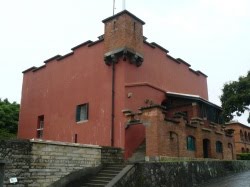 Visitors to the Ft San Domingo紅毛城 in Danshui will know that it was initially built by the Spaniards in 1628. The name was in honor of Saint Dominic, founder of the Friars Preachers [the Order of Preachers (OP)], commonly known as the Dominicans. It was later re-built by the Dutch (finishing in 1646) and re-named Ft Anthonio. The fortress was subsequently repaired and occasionally maintained throughout the Ming-Cheng dynasty and the Qing era. The Brits then leased it from the Qing in perpetuity in 1867/8 and the original name in Spanish was officially retained. To the locals, however, the fortress is always the 紅毛城 [literally City of the Red-haired].
 The original name of this temple is 鄭成功祖廟Koxinga's Ancestral Shrine (see the plaque under the eaves in the structure below). It was built by Koxinga's son 鄭經Cheng Jing in 1663. In other words, it only accommodates the Koxinga branch of the Cheng Family. There are no other temples honoring Koxinga's brothers.
 At the altar, a wooden statue of Koxinga can be seen:
 In the front garden area, a statue of Koxinga and his mother Lady Weng was recently erected. It is a copy of the original located in Koxinga's birthplace in Hirado, Nagasaki. In the inner courtyard, a bamboo tree planted by Koxinga's principal wife Lady Tung has survived to this day:
 This temple is now extended to include all Cheng's regardless of their ancestral link - whether it was with Koxinga or his father Cheng Zhi-lung or even no links at all, hence the 鄭氏家廟 designation. A world congress will be held on Nov 6, 2011. All Cheng's are welcome!
 [In the picture are the Harada and the Yamamoto families, the latter then visiting from Japan. And to the left and right are Mr Hirokawa's mother, then a teenager, and grandmother, the manager of 公會堂 from 1930-41.]
 [This picture was taken at 油車口 near the entry to the now Danshui Golf Course. In it, Mr Kinoshita Seigai (one with the white hat next to the drummer) and Mr Hirokawa's father (one with the megaphone on the cart) can be readily identified. On the right is of course Danshui River and Guan-yin Mountain.]
 This complex was destroyed in 1974 to make room for Taipei County Martyrs' Memorial台北県忠烈祠. Only the stone steps and the foundation survived.


 [Above: In subsequent years, Mr Hirokawa as a child, was carried by his Dad to participate in the ceremonies for students.]
 [Above: The vision of Blessed Guala, by Cosimo Gamberucci, from the Great Cloister of Santa Maria Novella, the principal Dominican church of Florence, ca. 1580]
 The Taipei Municipal Zoo or "Muzha Zoo木柵動物園" was actually relocated from Yuanshan in 1986. The original Yuanshan Zoo圓山動物園[Maruyama Zoo] was established in 1914 by a 70-person touring circus from Japan. It was taken over by the Colonial Gov't in 1915 and quickly became a very popular site with more than 800 visitors on any given Sunday. This Zoo housed about 70 species of mammals, birds, and reptiles. The picture above shows one of the main attractions, an Indian elephant named Malan [note: another, Lin Wang, was added in either 1952 or 1954].
 Then there was this exotic "fire-eating bird食火鳥", the most dangerous bird in any zoo, that had somehow avoided the euthanasia and survived the war. For illustration purposes, a representing photo here:
 The fire-eating fame of 火喰鳥 (hi-ku'i-tori) originated from 1778 when the strange flight-less bird arrived in Nagasaki, Japan, on a Dutch merchant ship. The painting above depicts a Dutchman in striped pants holding a piece of flaming charcoal for the bird, called Cassowary, to eat. No one has ever witnessed such an event at the Yuanshan Zoo or elsewhere, however. The bird apparently eats fruits, insects, and small animals; everything except fire. Many of us still feel duped.
 Alexander the Great (356-323BC) also had heterochromic eyes, probably from injury to the sympathetic nerve along the external carotid artery when his dad, Philip II of Macedonia (382-336BC), or someone picked up Alex the toddler by his head and inadvertently stretched the young neck. This type of nervous damage prevents proper pigmentation of the iris resulting in a blue eye on the afflicted side.
