2010年4月29日 星期四

In search of the Tung-luo clan 東螺社人

Immediately after the surrender of Ming-Cheng or Tung-Ning Dynasty, turncoat 施琅Shi-lang (1621-1696) began ruling Taiwan as 福建水師提督Admiral of Hokkien Navy. This position continued for 37 years from 1684-1721 and it was held by 施琅, 張旺, 吳英, and 施世驃 (施琅's son). The 施 father and son governed Taiwan for a total of 25 years, who, together with their cohorts, took over huge tracks of land as war spoils and levied exorbitant taxes on the residents of Taiwan. Confiscatory taxation, started by 施, was the fundamental reason why there were one uprising every 3 years and one revolt every 5 years during the Qing rule. 施琅 alone amassed 7,500甲 of tillable lands (1甲 =9,699 square meter) or half of southern Taiwan. The yearly 1,200 silver taels of licensing fee from the fishermen in PengHu paid to 施 did not end until 1737, 41 years after his death. And those lands were known as 施侯租田園, the rental harvests collected from generations of tenant farmers and sent to the 施 family in Beijing continued until the Japanese colonial gov't abolished this archaic practice and nationalized their lands.

The Ming-Cheng dynasty lasted 22 years, most of which under Koxinga's son 鄭經. The Chengs' mission of re-taking the Ming territories from the Manchurian Qing required that the military machine be well-oiled. And to generate revenues for the preparation for wars, trading with Japan and SE Asia was vital. This became increasingly difficult after the Qing shut down the east coast of China where valuable merchandises must pass through. Export of sugarcane sugar, deer hides, and other commodities from Taiwan became a major source of income. Locally, a taxation system was also instituted. To increase productivity and tax receipts, the gov't encouraged migration of Han Chinese to Taiwan and its own soldiers were also allotted lands to inhabit and develop (known as the 明鄭屯墾部隊) - often at the expense of the Aborigines. These settlements were quite extensive with the bulk in southern Taiwan stretching all the way north to Danshui. The Han population of 100,000 at the end of the Dutch period increased to 200,000. In other words, 施琅 had inherited a vast tax base, not a sparsely populated island with only Aboriginal subjects that paid token tributes.

For the especial interest of this blog, we should point out that in Taipei County area, the following Ming-Cheng sites survived to this day: 桃澗堡 (the first settlement), 南崁港, 芝蘭三堡(i.e., 淡水港), 芝蘭二堡(唭哩岸), and 芝蘭一堡(大直).

In 1684, the Ming-Cheng soldiers and military-settlers (totaling about 10,000 men) were forced back to mainland China and the latter's lands taken over by the so-called "Hoklo-speaking Pinpu tribesmen or 閩南語化平埔族人". Thirty seven years of Dutch rule had failed to produce any identifiable Dutch-speaking Aboriginal groups and yet in 22 years of Ming-Cheng, they not only battled the Ming-Cheng soldiers but also learned to speak Hoklo at the same time? Based on this improbable scenario, some have postulated anyway that all Han-people then in Taiwan, not just the military, were all repatriated back to China, the Hoklo-speaking Aborigines [note: more likely Han in disguise] were therefore able to multiply quickly and populate all of Taiwan. They also cite the first of the Five Bans by the Qing, in support:

1. 渡台之禁 (no migration to Taiwan - more below)
2. 入蕃界之禁 (no entry into Aboriginal territories)
3. 冶鐵之禁 (no ironworks - except the officially sanctioned 27)
4. 竹筏之禁 (no bamboo raft construction)
5. 官吏攜眷之禁 (no families of the officials allowed - so that in time of trouble, the officials do not seek to protect their families first)
2-4 were unenforceable and were unceremoniously lifted in 1874 on the eve of the Sino-French war.

There has been quite a bit of misunderstanding as far as Ban No 1. First and foremost, it was not a total ban. It was immigration by permits and indeed only men were allowed. The purpose was to continue the Qing's Han-controlling-Han policy, for the newcomers to replace the original settlers. It was during this period that some of the Han-Chinese, known as the 羅漢腳 (temple-dwelling homeless bachelors), intermarried with the Aborigines, more for the latter's property rights than love. [And in a different vein, some propose that their offspring were the ancestors of the modern-day Taiwanese.] This, however, is not to say that no others showed up in Taiwan at the same time.

The first Qing royal inspector to Taiwan 黃叔璥 reported that "終將軍施琅之世,嚴禁粵中惠、潮之民,不許渡台。蓋惡惠、潮之地素為海盜淵藪,而積習未忘也。瑯歿,漸弛其禁,惠、潮之民乃得越渡。" Essentially, after 施琅's death, the ban was loosened and even the previously forbidden Cantonese Hakkas were moving in. The ban was never effective in the first place. Even during 施琅's time, there were many ways of circumventing the ban, thanks to the corrupt Qing officials who regarded Taiwan as a gold-mine to get rich from:

1. The time-honored bribery at one's hometown or port of origin for a permit
2. Bribery at the port of entry
3. Smuggled in via flat-bottomed junks
4. Landing at remote areas/sites
5. Using forged permits

There have been studies on the ancestry of Han-assimilated Aboriginal clans. The one by Prof 張素玢 is particularly enlightening. [Much more can be found in this publication, Section 2. In her exhaustive search of the 東螺社人, she has discovered the first male ancestor of the 茆Maw family in 二水Er-shui, Changhua, was a Mr 茆芽, born 1649 and died in 1694. His original name was actually 王Wang. He was from 漳州府詔安縣甲二社 in Hokkien arriving in Taiwan in his 30s [probably as a follower of the Ming-Cheng]. His name change indicated that he was either adopted by the 茆s or had assumed it through marriage. It was most likely the latter as most of his descendants had moved to 埔里Pu-li area in Taichung in 1827 and were identified as Aboriginal in the local registers. So Mr 茆's was a perfect example of the Han-Aboriginal intermarriage. 茆 is not a Chinese name, BTW; it is a shortened phonetic version of the original Aboriginal name. The 茆 family rule prohibits marriage to any 王s, a Chinese custom of no same-name marriages that also indirectly confirms 茆芽's origin.

And the reason why the 東螺社人 migrated out? Loss of ancestral lands to the Han-people. One such Han family is the 陳Chens who chose to settle in 二水 from nearby 田中Tian-jhong, having bought several parcels of land from the 東螺社人 (with the purchase agreement to prove) some 200 years and 7 generations ago. They were the Han-Chinese migrants arriving in Taiwan for a better life, not Aborigines who had adopted a Han name.

The Chens and numerous other Hokkien and Hakka immigrants who arrived in the 18th century from China with or without their families were the reason why the subsequent population increase in Taiwan. The plains Aborigines lost their homelands to the Han people and moved away in two large-scale migrations, the first in 1804 to 宜蘭Yi-lan followed by another in 1823 to 埔里Pu-li, but ultimately they were all absorbed, culturally, by the ever-expanding Han immigrant population.

2010年4月18日 星期日

Japanese orphans in China 中国残留日本人孤児

[Maestro Ozawa Seiji - we wish you a speedy recovery.]

In 1685, 500 藤牌兵 from Taiwan fought the Russians in Albazin, north of the Amur [the Black Dragon River黑龍江]. In the late 1930s, many Taiwanese went, in a supporting capacity, with the Japanese military to serve south of the Amur in 滿洲 - or 東北 [the Northeast of China, used to be 9 provinces, now 3: 遼寧, 吉林, and 黑龍江]. The Taiwanese certainly traveled far.

So how and why did the Japanese get there in the first place?

By the end of the 19th Century, there were already Japanese settlers heading for 東北 region. This continued unabated through 大正 (1912-1926) into the early 昭和 era. And large-scale Japanese migration into "滿洲" (and later "滿洲國"), orchestrated by the infamous 関東軍, went into full swing from 1932 onwards until 1945 [Note: A good summary of the Japanese “Agricultural Emigration” during this period can be found in: http://arts.monash.edu.au/publications/eras/edition-5/mcdowellarticle.php]

Also, the putative intents of the mass migration in the early 1900s were to counter Russian expansion and to resolve Japanese rural economy crisis. By some accounts, early settlers were led to believe that they were to populate unclaimed open lands. However, from 1932 on, the settlers were organized for a de facto takeover of 東北 farmland – often via forced acquisition from native farmers. Eventually, the whole enterprise, emboldened by China’s 不抵抗主義, degenerated into empire-building that culminated in the war with China and beyond. By September, 1944, there were 1,662,234 Japanese residing in 東北 and most were sent back to Japan in 1946-8 (see 葫芦岛市政府辽宁省社科院: “Repatriation of one million Japanese via Huludao” – some parts are available online).

Most famous among those repatriated young ones are the future music director of Boston Symphony Orchestra Seiji Ozawa (小澤 征爾, born in 1935 in 奉天, i.e., 瀋陽, father a dentist), and movie actor Toshiro Mifune (三船 敏郎, 1920-1997, born in 青島, grew up in 大連, father a professional photographer).

And it was probably the massive Han people migration into 東北 that actually saved it from being dominated by Japan. Han people went from 6 million in 1897 to 15–17 million at the end of the Qing dynasty. After that,the Japanese tried hard but could manage ultimately only 1.66 million settlers by 1944. By this time, the Han population was well over 17 million.

Since 1945, there are newly discovered/reported old consequences:

There have been a few thousand "中国残留日本人孤児" – abandoned Japanese babies/children adopted by Chinese foster parents in 1945 amidst disease, death, and destruction. In scenes that no doubt have repeated numerous times in all wars: most children were found alone crying by the roadside, some by the dead bodies of their mothers, and some were just infants left behind in vacant houses (detailed in http://japanfocus.org/products/details/2195). Their existence was first uncovered in 1965 by a group of Japanese journalists then visiting 鞍山. Very few of these children were adopted through formal arrangements, most were simply left behind because their parents either were dead or could not care for them any more. While most adopted children were treated as their own by the foster parents, some had lived on the margin of the Chinese society. And for others who returned to Japan after the 1970s, they found themselves again living on the margin of the Japanese society because of the language and culture barriers. A few Japanese families actually refused to acknowledge these orphans - in a way, also a denial of the painful past. Many foster children had elected to stay in China, before returning to Japan, to care for their now elderly Chinese parents. Most did re-enter the Japanese society.

There was an NHK 1995 TV series, 大地の子Son of the Great Earth, describing the life of such an abandoned little boy. Readers my wish to look it up.

There is more: In the 2004 "War Orphans" list released by the Japanese government, there was one baby girl adopted by the Russians. The description of her case in http://www.kikokusha-center.or.jp/joho/mihanmei/h16/h1612.htm reads [translates]: "On Aug 17, 1945 [note: Japan had surrendered on Aug 15; although fighting continued until Aug 26], near 牡丹江市, 掖河 Station, the Japanese armed forces were attacked by Soviet forces [note: no survivors on the Japanese side]. The baby was rescued by a Soviet soldier named "ミフリャ [note: this is pronounced Mifuliya but more likely, it’s Mifodzia] [note: the baby was crying among the ruins and was therefore discovered by the soldier]. When found, it was wearing a reddish brown coat, a yellow shirt and pants, and was wrapped in a blanket. Its nose was wounded by artillery bombardment." The baby was given the name "ニーナイヴァーノヴナポリャンスカヤ(Нина Ивановна Полянская)" [note: first name Nina that of the Russian nurse treating the wounded baby, middle name Ivanovitch that of the discovering Soviet soldier, and last name Boltyanskaya means "grand vision"] and later adopted by a Russian family. She visited Japan briefly in 2004 but chose to go back to Russia. She has never fully recovered from her wounds.

It was clearly a disastrous summer in 1945 for the Japanese settlers. Mass suicides were common. Some the then children now recall, in the ensuing months, the hunger, the winter cold, the deaths of siblings, hiding from the Russians, and yet retain fond memories of the place they used to call home. And because menfolks were sent to fight wars elsewhere, the remaining families became refugees amidst overwhelming hostilities. The ones escaped through Korea had an especially hard time; see, for example, the book "So far from the Bamboo Grove" by Yoko Kawashima-Watkins, New York, Viking Penguin, 1987 (Puffin Book). Its recollection of the maltreatment of the Japanese women-refugees by the Koreans has stirred up controversies leading to its ban in Korea, China, and some schools in the US [see here].

More about these Chinese foster parents: In one example of an interview in http://www.china.org.cn/english/features/141004.htm, "I did hesitate a little after we learned that it was a Japanese child," said Zhang Zhilan, Ran's foster mother. "I hated the Japanese army very much. They were so atrocious, killing Chinese civilians as if they were chopping a tree. But looking at the newly born infant, I made up my mind. If I was not going to raise him, he would soon die. After all, the child was innocent."

It is hard to imagine in the chaos of the war, some Chinese peasants who came across crying children/infants dressed in Japanese garments and decided on the spot to bring the children home. The Japanese reports describe them as 善良の中國百姓. It is far more than that because we are talking about 4,000 such children, not just a handful. This is a core character of Chinese farmers, far more benevolent, humane, and loving than others gave them credit for. It might have been the hundreds of years of influence from Buddhism, an ingrained morality if you will. For example, this saying "救人一命, 勝造七级浮屠 - Saving one life is even better than building a seven–storied pagoda" alone might have been very important in the farmers' decision to adopt.

2010年4月10日 星期六

Who are Taiwanese anyway

[A map of Aboriginal tribal areas in Taiwan including both Plains and Mountain tribes.]

Here is a view from Danshui:

It is interesting to see the search for Taiwanese identity continues in earnest. Some in Taiwan now disclaim their Han heritage and embrace ever so tentatively that of the Aborigines. While there is a true desire to know, there is also a separatist political undercurrent in both inter- and intra-national senses.

This disclaimer, however, seems to have built upon a deliberate misunderstanding of the terminology used in a 1905 census survey - the first of several conducted by the Japanese.

There were several people categories in this census: (1) Japanese from mainland Japan; (2) residents of Taiwan (based on domicile and residence history); and (3) foreigners and others. Category (3) included "清國人Qing Chinese" and Koreans. It is the designation of this "Qing Chinese" that has prompted some to declare that it means the Han people then residing in Taiwan were foreigners. And according to the census, these people were very few in number (8,083). The vast majority in category (2) therefore can be presumed to be Aboriginal.

To support this Aboriginal theory, it is necessary to minimize the number of the Han people. More theories therefore must be and have been created. To name a few:

(1) Taiwan residents' being originally from Hokkien or Canton was a fraud perpetrated upon the Aborigines by the Qing;
(2) When the Ming-Cheng soldiers were being exiled to the penal colonies in China, 12,724 of them were too destitute to go, hence the Han population in Taiwan should start with this number;
(3) Because of the ban by the Qing on the Han family/female immigration to Taiwan, the 2,979,018 Taiwanese by 1905 must be of Aboriginal descent (i.e., how else could the Han men propagate);
(4) The arrival of any number of Han Chinese during the Qing era is deemed unlikely because of the difficulties in crossing the Taiwan Straits;
(5) The prefectural archives in Hokkien show only a handful of emigres to Taiwan during Qing rule;
(6) A white-cell HLA antigen study suggests that 85% of Taiwanese have Aboriginal genetic markers; and so on.

Despite these arguments, however, the "清國人" fundamentally can only refer to those arriving from China after the Japanese take-over in 1895, i.e., they were citizens of the then 大清帝國, the Qing Empire.

The 1905 Japanese survey was based on three administrative levels of (1) 廳 (prefectures); (2) 堡/里/市/嶼/澳 (cities and towns), and (3) 街/庄/村/社/鄉 (neighborhoods), all of which inherited from the Qing era. A survey done in 1893 (光緒十九年) showed a total population of 2,545,731, up from 1,944,737 in 1811 (嘉慶十六年). The surveyed areas were nearly identical, i.e., the central highlands and Taitung were excluded [except Taitung was included in the aforementioned 1893 census with a total of 6,000]. The map below is from the Japanese colonial period showing mountain Aboriginal territories in different colors - census-taking was conducted outside of these areas. The boundary markers between the Han and the mountain Aboriginal regions throughout Taiwan, etched in stone, were in existence since 1722 (康熙六十一年) if not earlier. In other words, the census data were a collection of both Han people and Plains Aborigines with Han surnames. It has long been argued that the Plains Aborigines lived among the Han. This is true but it only applies to the occasional few as individuals. The reality is that villages in Taiwan were segregated starting in the Ming-Cheng era.

(Source: http://taipics.com/aboriginals-set-6 - this site hosts a huge collection of old photos, pics, and maps of Taiwan.)

During Ming-Cheng, the administrative districts of southwest Taiwan [the Greater Tainan area] actually separated the Han settlements [民社] from the Aboriginal hamlets [番社]. A Ming-Cheng study map copyrighted by Academia Sinica can be found here. [Note: The lone Han settlement in northern Taiwan was Danshui, then called the "上淡水城".]

This distinct segregation, especially in the rural areas, has continued throughout Qing and Japanese rules up until today. Urban areas eventually grew from Han administrative/population centers; however, there have never been any cities dominated by the Aborigines. It is questionable if inter-marriages were necessarily wide-spread or even necessary at all in the first place. In 1666, between 150-200,000 Han people had already settled in Taiwan. This number would change owing to the many subsequent wars but certainly not to the paltry 8,083 by 1905.

Here is a good example accounting for the arrival of Han settlers: "Research on the Development of Niu-Ch'ou River Basin Before 1895" a PhD thesis by 黃阿有, NCKU, 2007. [Note: the Niu-Ch'ou牛稠溪流域 refers to an area northeast of Chia-yi City.] A direct quote from the summary: "...There were some Chinese villages in the 17th century and by the start of Ch’ing’s rule, it was estimated that there were 32 Chinese villages and 8 garrisons. Land developer villages grown to 100 in 1683-1722, and 76 added in 1723-1795. In the end of the 18th century, approximately 97% of the villages had Han developers. This revealed that the quarantine policies in the early Ch’ing rule didn’t work well." This was the general trend of the Han population growth in Taiwan, i.e., a vast influx of Han immigrants over time.

Our simple-minded observations:

(1) While intermarriages between the Han and the Plains Aborigines clearly had taken place - to what extent and whether confined to a certain era/area, however, are all still unknown;
(2) The request for adopting a Chinese surname by the Aborigines had been officially granted during Qing, but not the ancestral family history lock stock and barrel, that was not part of the deal;
(3) The immigration of Han Chinese after Shi-lang's death is also a historical fact notwithstanding the potentially unkept archives in the war-torn Hokkien during the Qing era; and
(4) The HLA antigen study simply means that most Taiwanese have Southern Mongoloid traits; unfortunately the data have been used, erroneously, to imply an Aboriginal ancestry of the Han Taiwanese - these two groups merely share some of the same traits as do many other southern Chinese/Asian peoples.

Have we forgotten anything? Ah yes, the 1905 survey questionnaires also included an item on foot-binding - strictly a Chinese custom. Maybe the number of females with bound-feet can provide much more reliable information on the proportion of Han vs that of the Aboriginal women. Of course, we suppose the quarrelsome ones can still argue that the Plains Aboriginal women (and the Hakka women) were foolish enough to submit to this barbaric practice.

In the long history of the Taiwanese, there have been many groups each dominating at a different time and/or place. And one can always cite numbers and records [including this blog] but that may pertain to only one specific part of the history. Indeed the Indian fable of the blind men and the elephant comes to mind.

Still, incessant discussion without any hard evidence is counter-productive. For those who can trace their family origin unequivocally, the heritage is never an issue. Others especially those who own a Chinese last name yet were/are from an Aboriginal 村 or area may still need a definitive answer. A large-scale forensic DNA analysis (preferably mitochondrial), to resolve who the great great great great-grandma really was, should be done to remove all lingering doubts.

(An elderly Aboriginal woman in Han dress wearing a wrist bracelet sitting in a wicker chair. She was probably of the 賽夏 - not the 泰雅族 - identified by the tattoos on her forehead but none on the cheeks. It is difficult to see her unbound feet in this photo taken in the 1950s in 苗栗Miaoli.)

This still will not be the end, though. Little realized is a much bigger issue with two opposing views: One side proposes that the Aboriginal land ownership can go all the way back to before the Dutch occupation, and the other advocates that the Aborigines were slaves with no property rights who were shipped in by the Dutch. In other words, the question of "who are Taiwanese" will eventually escalate into "who owns Taiwan". Then all of a sudden we will be confronted with China's asserting her sovereignty rights over Taiwan. The consequence can be a very unpleasant 鷸蚌相爭,漁翁得利. The intensity of the separatist debate now will certainly pale in comparison.

2010年4月4日 星期日

Poisson chanteur de Rivière Tamsui - Singing fish of Danshui River

A collection of correspondences, spanning August 23, 1884 to June 22, 1885, appeared in "la terre illustrée" (Illustrated Earth magazine, 1890-1891), under the heading of "Le mousse de l’amiral Courbet: Campagne de l’Indo-Chine - Fou-Tchéou et Formose" [The Apprentice of Adm Courbet: Indo-China Campaign - Foochow and Taiwan]. They were letters written by a young French sailor to his mother and one of his buddies back home in Paris. This man seemed to be in the close proximity of Adm Amédée Courbet (1827-1885) and was quite knowledgeable - he was able to record in great detail the people and places of northern Taiwan and was privy to the high-level discussion involving the battles of Keelung and Danshui.

In one part, he wrote: "Donc le 30 [septembre 1884], c’est à dire avant-hier, nous sommes arrivés devant Kelung, une jolie plage, dominée par des collines. Au-devant, un peu sur la droite, une île qui a exactement l’air d’un hippopotame." ["So on the 30th [September, 1884] or the day before yesterday, we arrived at Keelung, a beautiful beach dominated by hills. In front, a little to the right, there is an island that looks exactly like a hippo."] That puts him on Courbet's flagship, Le Bayard [see here]. In later reports, although unlikely yet he appeared to be present at the battlefield in Danshui with first-hand account of the confusion and the hand-to-hand combat on the beach.

He was apparently fascinated by tales of the sharks in Taiwan. The ones with the head of a human female and evil eyes, and those that eat birds.

Another passage in particular catches our attention: "On dit encore - mais j’ai besoin de le voir ou plutôt de l’entendre pour le croire - que dans une rivière appellée Tamsui, il y a des poissons qui chantent." ["They say, but I still need to see or rather hear it to believe it, that in a river called Tamsui, there are fish that sing."]

Let's see, there were/are tiger sharks in Danshui River and they did bite teenagers who swam in it. These sharks of course don't sing; neither do they possess a woman's head, nor would they leap out of water to catch a flying bird.

And there are so many different fish in the River, too: 豆仔魚, 烏魚, 小金錢仔, 小花身, 黑格, 海鰱仔, 大成仔丁... [For much more, please visit our 登峰魚丸博物館Fishball Museum on 117 Chung Cheng Road in Danshui.]

Wait, the 金錢仔, known locally as the "kim-tsîn-á", do sing!! They sound like male frogs looking for mates. And we have always thought that they were just voicing their displeasure when caught.

Too bad this gentleman did not get to see and hear the fish, or he'd have known more about them:

Chinese name: 高背鰏
English names: Slimy, Slipmouth, Pony fish, Common ponyfish
Nomenclature: Leiognathus equulus
Other local names: 三角仔, 狗坑仔

Dasnhui could have ended up a French colony and the French could have then even caught and eaten the fish. Of course that did not happen. Merci, mon Dieu (or Ma-Zu, for that matter).

These little 金錢仔 are still plentiful; unfortunately, they and other fish from Danshui River are no longer fit to eat as the River has long been polluted.

Additional message from 登峰魚丸博物館: the nomenclature of fish should be italicized:

2010年3月31日 星期三

News on Dec 24 1945

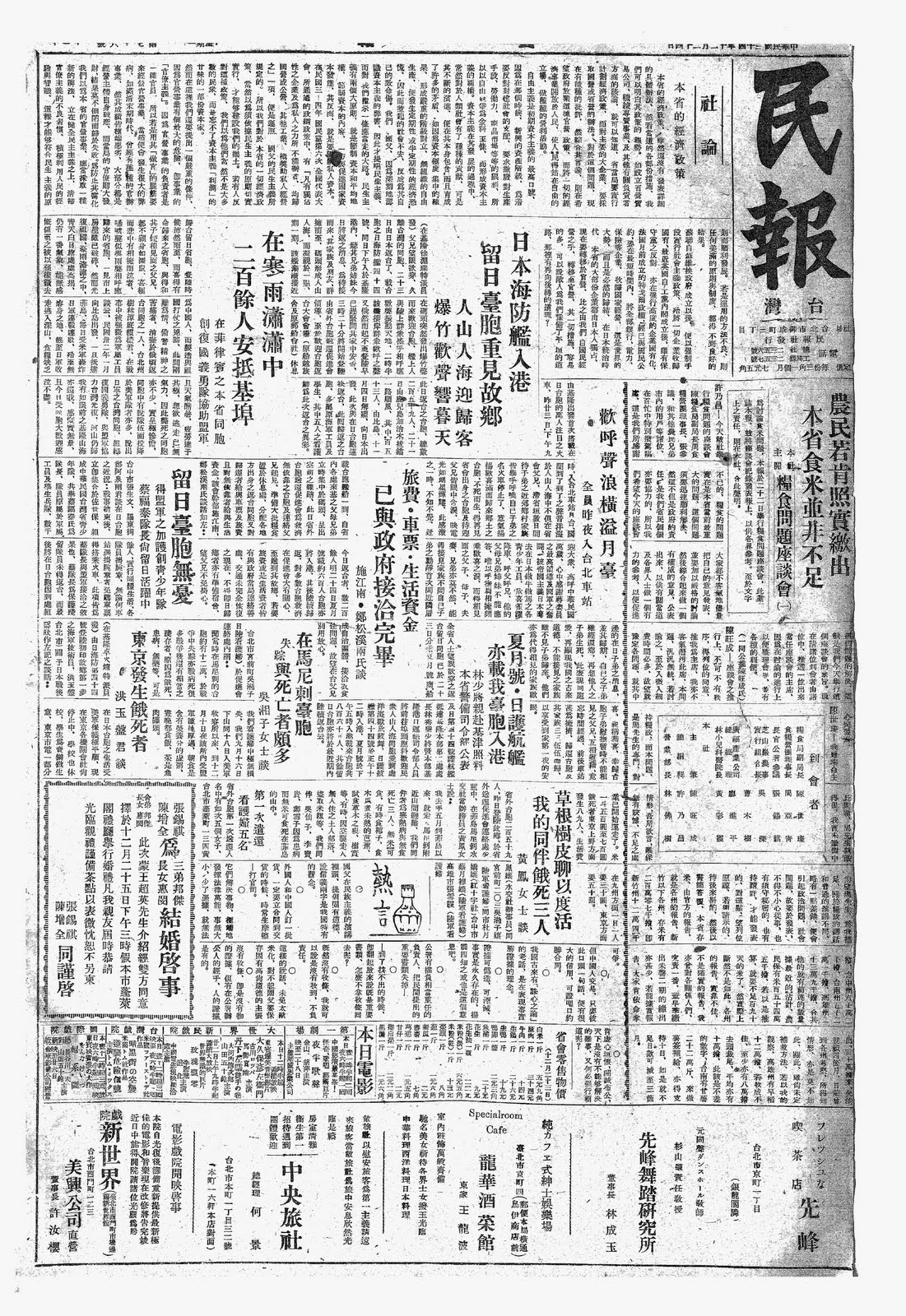
The Japanese went back to Japan in 1946 (see here), but when did the Taiwanese stranded outside of Taiwan start coming home?

民報, a newspaper published in Taipei, reported on Dec 24, 1945, that on the previous day, the first group of 865 Taiwanese had arrived in Keelung; 259 were on board the IJN No 44 海防艦escort ship [patrol boat] arriving at noon and the rest on the transport 夏月Natsugetsu [a converted destroyer], at 5PM. Both ships departed 加治木Kajiki, 鹿兒島Kagoshima on the 21st. And 153 of the 259 sailed on Nov 4 from the Philippines to Japan and then joined the others. At 9PM, this group arrived by train in Taipei Station into the welcoming arms of the happy family members.
(Click to enlarge - do it twice to see the details)

Accompanying this news article are stories on the lives in the Philippines and Japan:

(1) Five Taiwanese army nurses survived the Philippines ordeal and returned home; 3 of their colleagues did not - who died of starvation;
(2) 89 Japanese died in the 上野Ueno District in Tokyo, also of starvation - blamed on the high cost of living;
(3) Of the 120,000 Taiwanese residing in Manila, many succumbed to the dismal living conditions, while many others went missing; and
(4) In Japan, several thousand apprentice soldiers and military employees from Taiwan were all safe and sound.

The editorial at the top was in support of the gov't's taking over the businesses previously nationalized by the Japanese - if the bureaucracy could be avoided. There is also a list of the price of various food items. And of course the inevitable advertisements, at the bottom: Movie theaters were showing Chinese and Japanese movies. A dance studio was recruiting ballroom-dancing students. And a hotel, a restaurant, and a tea house looking for clients plus an announcement of the opening of a new movie theater.

And on page 2:
Gen Douglas MacArthur denied for the second time that he had resigned and claimed that he would be in Japan to complete his duties, not to obstruct American policies. Three high-ranking Japanese officers and 40 soldiers in Borneo were being tried for committing war crimes - in the killing of 550 British POWs. In 中壢Chung-li, a "bad-egg" Japanese official was found to have destroyed maps/documents on the irrigation system. In Kaohsiung, the 64 Aboriginal 社s (population 22,058) would now convert to self-ruling 村s. And 1,774 students took the first post-war entrance exam to National Taiwan University.

At the bottom are the weather report, a treatise on 魯迅Lu Xun's poems (Lu, a famous Chinese poet who briefly studied medicine at Tohoku University in Sendai, Japan), a new-style poem (part 2) by an unknown poet, and Sec 23 of a long novel by 吳漫沙 (a famous author born in Hokkien).

Preparations for the New Year's Day celebration were also underway.

Life was good.

[A postscript: 民報 was forced to shut down on Mar 8, 1947, and its president Dr 林茂生 murdered.]

2010年3月25日 星期四

Special Forces Part 2 - The Black Rifle Battalion

Even though 鄭成功Cheng Chen-Gong [國姓爺Koxinga] (1624-1662) is a household name in both Taiwan and China yet his life remains relatively unknown in the West. A few words here maybe appropriate:

Koxinga was a King who commanded a very well-structured military of some 100,000 men. He was 延平王 (King of Yan-ping) and whose war-machine was respected and feared at once by all who had crossed his path, unwittingly or otherwise. This path was actually a very narrow one: 反清復明[Rebel against Qing and restore Ming]. Period.

Koxinga was educated a Confucian scholar who later, at age 23, became a military leader under very trying circumstances: First his father 鄭芝龍Cheng Zhi-long surrendered to the Qing violating a cardinal Confucian rule of honoring thy emperor at all costs, then his Japanese mother 翁夫人Lady Wuon (aka Mrs 田川松Takawa Matsu氏, 翁 was her adoptive parent's name) committed suicide when the Qing invaded Koxinga's hometown. He burned his scholar's robes at the Confucius's Temple bidding farewell to a university student's life forever, and answered the personal call from the Ming emperor to rescue the latter's failing dynasty. The emperor-in-exile 隆武Long-wu rewarded him by conferring the honor to use the royal family name "朱" [hence 國姓爺 as he was respectfully referred to by the common people] - the emperor did not have any daughters to marry Koxinga into the royal family. And the last emperor-in-exile 永曆Yon-li promoted him to a second-tier kingship 延平王. The title 延平郡王 was a posthumous honor from the Qing emperor 光緒 in 1875 - by then all were forgiven and Koxinga was regarded a Chinese hero for driving away the Dutch from Taiwan. It was a politically expedient way of rallying the Taiwanese during the Sino-French war era that is to continue to this day. And whatever had happened to the Ming-Cheng soldiers in the penal colonies in mainland China has remained totally ignored, also to this day.

There were two main branches in Koxinga's military, the Navy and the Army. The Navy had 9 fleets reportedly with "hundreds" of vessels. One fleet, the 內司鎮 was directly under the flag of Koxinga. Larger warships in the 樓船鎮fleet were triple-deckers with fire power that could easily overwhelm the best of Dutch galeons and indeed had done so in the battle for the recovery of Taiwan. [Insert: a model of one of Koxinga's ships, on display at 石井鄭成功記念館 in 南安Nan-An, Hokkien.]

And the Army was organized thus: (1) Guardsmen of several special forces directed by Koxinga himself and (2) General Troops under various commands. The latter consisted of 9 different infantry groups ranging from 5 specialty companies to 28 squadrons in each group. One of them, the 後勁營 (the Rear-Guard Battalion) was built with Northerner Chinese. The special forces included (1) the Left and Right Martial Guards (or the Golden-armored battalions - infantry with traditional Ming armor); (2) the Left and Right Tiger guards (i.e., the Iron-man Corps); (3) the cavalry battalion; (4) the artillery battalion; and (5) the palace guards - including a Black matchlock rifle battalion.

A battalion of Black soldiers? Yes. And they were specialists in the use and maintenance of the 種子島[銃]Tanega-shima matchlocks purchased from Japan. They were also able to produce these rifles, known as 倭銃, later on.

(Above: A Japanese matchlock rifle in action. In 1543, the Portuguese had either landed on Tanegashima [the Seeds Island], off the southern shore of Kyushu, or on-board of a ship by this name [?] and visited Japan. The Portuguese had brought with them the matchlock rifle. Enterprising citizens of the island quickly began manufacturing the rifle [see below] which Koxinga's army was equipped with.)

So who were these Blacks? Here we'll provide a short summary:

Blacks from South Africa (the Cafres) (and later also from South Pacific and East Asia) began to arrive in China at the end of the Ming Dynasty. Some were brought in by European traders as slaves/servants. Others had enlisted to serve in the military of the Portuguese and the Dutch for religious reasons, i.e., to spread Christianity in the East. And their bravery and fighting capabilities were quickly noticed by the Ming-Chinese.

In the early 1600s, most of the Blacks resided in Macau. They in fact were the main component of the Portuguese contingent who had fought off the Dutch in 1622. There was a report noting a female Black warrior, in man's garb, who had single-handedly killed 2 Dutchmen in this battle.

In 1647, about 200 of the Macau Blacks sought freedom as well as a better life. They left Macau and went over to Cheng Zhi-long in Hokkien who eventually employed 300 as his personal guards. Cheng had consistently honored their Christian belief possibly because he himself was once a Christian.

According to 何大化[Ho Da-hua], "…唐王[隆武帝]依靠一個福建人[指鄭芝龍]的勇敢與忠實在該省會[福州]設朝。他[鄭]年輕時曾在亞馬港成為基督徒,後從事海盜生涯,現在榮華富貴,將其義務忘得一乾二淨;但他手下有300個各種民族的黑人。他們都是基督徒,是他十分信任的衛兵。" [The Ming Emperor in exile, Long-Wu, had relied on a courageous and loyal Hokkienese (i.e., Cheng Zhi-long) to establish his royal court in Foochow... In Cheng's younger days in Macau, he had converted to Christianity but later became a pirate. Now that he was rich and famous, he had totally forgotten his duties (to the Ming). Under his command, there were 300 Blacks of all races. They were all Christians and were Cheng's most trusted guardsmen.]

A side issue here: Labeling Cheng Zhi-long a "pirate - one who engaged in robbery at sea" was incorrect. To the Chinese merchant ships, his privateering navy provided much needed protection in the trade routes between China and SE Asia from harassment by ships of dubious origins. His operation became legit later when he joined the Ming (1628). Then he unwisely defected to Qing (1646) and tried to convince Koxinga to do the same, in vain. He was eventually executed by the Qing on the 3rd day of the 10th month in 1661, together with 11 family members, including his 3rd son 世忠(世渡), 4th son 世恩, 5th son 世蔭, and the youngest 7th son 世默. This news hit Koxinga hard, who went into deep depression and passed away soon after at age 39.

Koxinga inherited these palace-guards and had also welcome them with open arms - even into his own household. In return, these Black warriors were fiercely loyal to the Chengs.

In battle, a banner with the image of Virgin Mary on it was proudly and prominently displayed. This Black Battalion was headed by a very talented Luis de Matos. They were usually deployed on the second line in support of the first-line offense. In the siege of Nanjing, they were seen fighting at the foot of the city walls near Yangtze River. And in the siege of Zeelandia, Koxinga's Black soldiers were able to communicate with the Blacks enslaved by the Dutch inside the fort, many escaped from it to join the Cheng army.

No one knows what had happened to the Black Battalion and their families [some had married Han wives] after the demise of the Ming-Cheng Kingdom. It was unlikely that they were sent to Mainland China or repatriated to Macau or even less likely, back to their homelands in Africa/Asia. There were no such records in any case. Most probably the 300 or so of them were simply disarmed and allowed to stay and die forever Taiwanese.

[Note: Black mercenaries were also involved in the 太平天國 revolt (1851-1864) and fought on both sides, but that is another story.]

2010年3月21日 星期日

Special Forces Part 1 - The Iron-man Corps 鐵人部隊

Presumably a contemporary German made the above sketch of Koxinga's Iron-man Corps, one of the many special forces of Koxinga's army. It shows infantrymen who donned a helmet, face mask, heavy chest and arm fish-scale armors, and a long heavily-armored skirt. They each carried a long spear or a broad-blade at the end of a stick - weapons for cutting down enemy cavalries. They were also accompanied by the rattan-shield infantry who erected inch-thick curtains to catch arrows and bullets. According to Chinese accounts, however, both arms and legs of these iron-men were exposed - for easier movement. And they went bare-footed for more steady footing. The Qing strategy of targeting their feet with arrows failed because the Iron-men would simply pluck out the arrows when shot and fight on oblivious to the flesh wounds.

The source of these armors was unclear; although it was most likely Japan: (1) there had been active trading between the Cheng Clan and Japan since the days of Koxinga's father, 鄭芝龍Cheng Zhi-long (1604-1661), who controlled the eastern seas of China; (2) Koxinga himself had grown up in Nakasaki, Japan, who might have seen the armored samurai in action; and (3) the face masks were known to be worn only by the Japanese (not Chinese) warriors. The picture on the above left, i.e., a 16th Century armor-suit worn by a high-ranking samurai, might have been just that used to outfit the Iron-man soldiers [without the arm and leg guards].

The selection of these men was quite rigorous. Each recruit must be able to carry a certain weight and with it ran a certain distance to qualify. Power and endurance were both prerequisites for wearing the heavy armors (weighing about 33 lbs) and fighting at the same time. About 5,000 were chosen during the first screening. Some reports mentioned Japanese and Caucasian participants. That would not be so surprising as the Cheng army did invite other people than the Hokkienese to join up.

This special force, numbering about 3,000 (up to 10,000), was part of the 左 and 右虎衛營 [Left and Right Tiger Guard Battalions] under the direct command of Koxinga. Its basic unit was a 6-man squad equipped with the heavy sword 雲南斬馬刀 (2), shields (2), bow and arrow sets (6). Also, for each 10 squads, 4 specialized in attacking with bow and arrow and the other 6, sword and shield. They were trained to fight as one, any disruption to the formation, by either advancing or retreating, especially the latter, was severely punished. On the other hand, they were handsomely rewarded after each victory and were paid 3 silver taels each month [double the regular army pay].

The unique weapon here was the razor-sharp 雲南斬馬刀 or Yun-nan horse-slaying saber-sword. Yun-nan was just its name, had nothing to do with the Yun-nan province. Legend has it that each blade was made by passing serially through 100 iron-smiths who hammered it into shape. This may have been a process similar to the samurai-sword-making in Japan, a long piece of soft iron core folded onto itself thousands of times (to give it flexibility) which was then encased in a hard steel shell (for sharpness and strength). And this is done by only one master plus 1-2 assistants. With 100 masters working at the same time, mass-production of the horse-sabers was therefore possible.

The Dutch defenders of Zeelandia had calculated that one Dutch soldier could fend off 25 of Koxinga's iron-men. They were fatally mistaken.